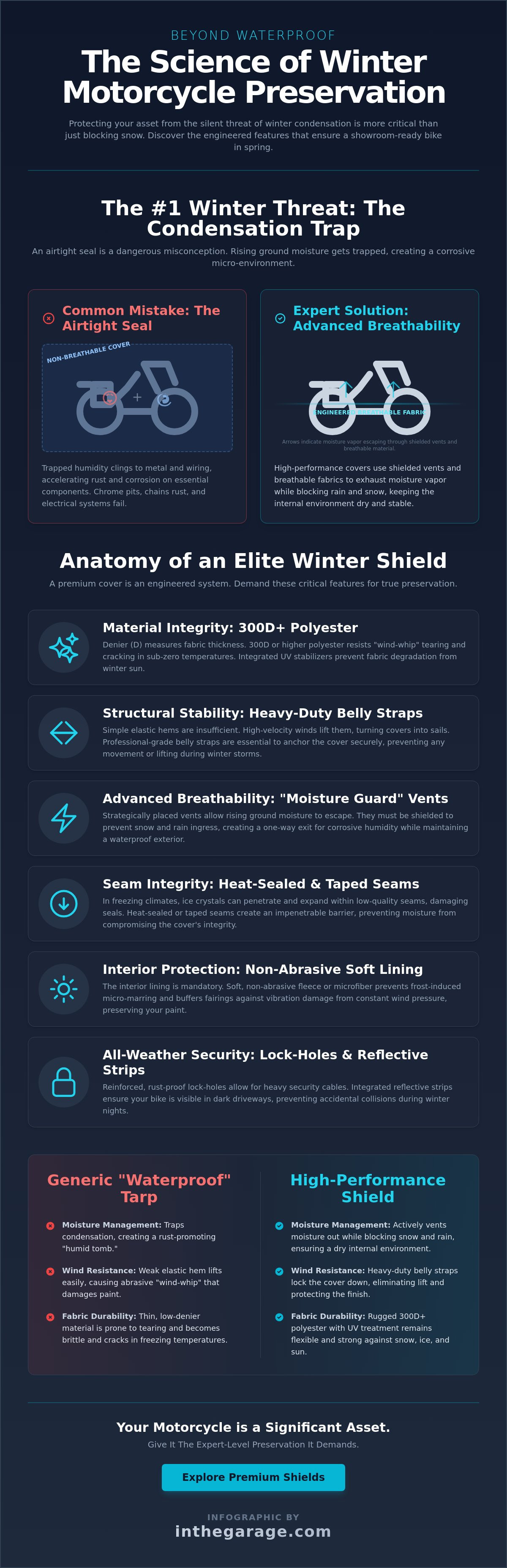
As winter approaches, the question for every motorcycle owner without a garage is the same: How do I protect my bike from months of snow, ice, and biting cold? Storing your motorcycle outdoors is more than just keeping it dry; it's a battle against the hidden enemy of condensation. A cheap, non-breathable tarp can trap moisture, creating a corrosive micro-environment that silently damages your chrome, paint, and electronics.
This guide moves beyond the outdated "waterproof tarp" mentality. We will explore the science of asset preservation and reveal why managing the atmosphere around your bike is the key to ensuring it emerges in spring in pristine, road-ready condition. For 2026, protecting your motorcycle isn't about blocking the weather—it's about controlling the environment.
##Table of Contents
-
Beyond Waterproofing: The Science of Winter Motorcycle Preservation
-
Essential Features for a High-Performance Outdoor Winter Shield
-
Selecting Your Shield: Traditional Covers vs. Outdoor Storage Bubbles
##Beyond Waterproofing: The Science of Winter Motorcycle Preservation
Many riders believe a simple "waterproof" cover is sufficient for winter. This is a dangerous misconception. The most significant threat to your motorcycle during outdoor storage isn't falling snow, but rising moisture from the ground. As the sun warms the cover during the day, even on a frigid afternoon, moisture evaporates from the damp ground beneath, gets trapped, and then condenses on your bike's cold metal surfaces as temperatures plummet overnight.
-
The "Condensation Trap" Defined: This cycle of evaporation and condensation creates a humid, corrosive micro-environment under the cover. It’s a greenhouse effect for rust, accelerating the degradation of metal parts, electrical connections, and even the finish on your engine block.
-
The Power of Breathability: True breathability is the ability for a fabric to exhaust water vapor (moisture) while blocking external liquid (rain and snow). This one-way transfer is the only way to defeat the condensation trap.
-
Protecting Your Paint: During deep freezes, any trapped moisture can form frost or ice crystals on the inside of the cover. A soft, non-abrasive inner lining is critical to prevent this frost from causing thousands of micro-scratches in your paint and clear coat as the cover moves in the wind.
The Moisture-Rust Cycle in Sub-Zero Climates
The physics of freezing water adds another layer of risk. Water expands when it freezes, and this can be catastrophic for a motorcycle cover's integrity. Water molecules can seep into the tiny needle holes of low-quality stitched seams. When this water freezes overnight, it expands, turning small punctures into significant breaches. These compromised seams then allow more moisture in, creating a self-perpetuating cycle of damage.
This is why professional-grade winter shields utilize heat-sealed or taped seams. This technology creates an impenetrable bond, eliminating needle holes entirely and ensuring the cover's waterproof barrier remains uncompromised throughout the freeze-thaw cycles of a long winter.
Material Integrity: Why 300D+ Polyester is the Winter Standard
The fabric of your cover is its primary line of defense. The term you need to know is Denier (D), a unit of measurement for the thickness and density of individual fibers. For harsh winter conditions, a rating of 300D or higher is the professional standard.
-
Resisting "Wind-Whip": Lighter fabrics (below 300D) will violently flap in high winds, a phenomenon known as "wind-whip." This not only abrades your motorcycle's paint but can also cause the cover itself to tear or disintegrate. A heavy-duty 300D+ polyester has the weight and strength to resist this damaging motion.
-
Winter UV Protection: Even weak winter sun emits UV radiation that can make fabrics brittle over time. Quality outdoor covers are treated with UV stabilizers that prevent this degradation, ensuring the material doesn't become fragile and prone to tearing after months of exposure.
##Essential Features for a High-Performance Outdoor Winter Shield
Beyond the core science of materials and breathability, a truly effective motorcycle cover for outdoor winter storage is defined by its features. These components are engineered to combat the specific challenges of a harsh winter, from gale-force winds to heavy snow loads.
-
Shielded Ventilation Systems: Vents are non-negotiable for promoting airflow and exhausting moisture. However, basic, open vents are a liability in winter. Look for "Moisture Guard" vents with hoods or shields that allow water vapor to escape while preventing blowing snow and rain from getting inside.
-
Heavy-Duty Belly Straps: A simple elastic hem is not enough to secure a cover against powerful winter gusts. A robust, adjustable belly strap that cinches the cover underneath the engine is essential to keep it locked in place and prevent it from being torn off in a storm.
-
Heat-Resistant Panels: After your final ride of the season, you want to be able to cover your bike without waiting hours for the exhaust pipes to cool completely. Integrated heat-resistant panels in the lower sections of the cover allow you to secure your bike quickly and safely.
The Internal Environment: Linings and Paint Protection
What touches your bike is just as important as what shields it from the elements. The inner lining of a winter cover must be engineered to preserve your motorcycle's finish against the subtle damages of long-term storage.
-
Non-Abrasive Materials: A premium cover will feature a soft, non-abrasive liner, such as fleece or microfiber. This gentle layer protects your fairings, fuel tank, and windshield from the constant, subtle vibrations and movements caused by wind, preventing dulling and micro-marring of the paint.
-
Finding the Right Fit: A precise fit is the first step in paint protection, as it minimizes abrasive movement. To find a shield tailored to your bike's specific geometry, you can explore the full range of precision-fit options in the In The Garage collections.
##Selecting Your Shield: Traditional Covers vs. Outdoor Storage Bubbles
For the ultimate in outdoor winter preservation, enthusiasts have two primary choices: a high-performance fabric cover, like the Outdoor Shield, or a technologically advanced inflatable system, such as the Outdoor Motorcycle Bubble. The best choice depends on your specific security needs, climate, and preservation goals. For a detailed breakdown, our motorcycle storage pod comparison offers an in-depth analysis.
-
The Outdoor Shield: This is a rugged, professional-grade fabric defense system. It uses advanced, breathable materials and robust construction to actively combat condensation and shield your bike from snow, ice, and wind. It's the definitive choice for high-performance passive protection.
-
The Outdoor Motorcycle Bubble: This system represents a paradigm shift in vehicle storage. It’s an active preservation environment that uses constant airflow to create a climate-controlled micro-environment, offering total isolation from the outside world.
-
Maintenance Tip: When clearing heavy snow from any cover, always use a soft-bristled brush or broom in a gentle pushing motion. Never use a shovel or sharp object, which could puncture or tear the fabric.
The Outdoor Motorcycle Bubble: Total Isolation
The Outdoor Bubble is more than a cover; it's a personal garage. Its rigid, inflated structure provides a touchless barrier, creating a significant space around the motorcycle. This design is the key to its effectiveness, as it allows a constant stream of filtered air to circulate, completely eliminating moisture and preventing condensation from ever forming.
-
Active Air Exchange: A high-pressure fan runs continuously, exchanging the air inside the bubble 3-5 times per hour. This active airflow maintains a consistent temperature and humidity level, stopping the moisture-rust cycle before it can begin and preventing 100% of condensation.
-
Structural Protection: The inflated shape is strong enough to withstand heavy snow loads and protect your motorcycle from falling branches, hail, or accidental bumps—dangers that a traditional fabric cover cannot defend against. For more on this technology, explore the rise of inflatable garages.
Winterizing Your Bike Before Shielding
Even the world's best cover works more effectively when the motorcycle itself is properly prepared for hibernation. Before you deploy your shield for the winter, run through this quick professional checklist:
-
Fill the Tank and Add Stabilizer: A full tank prevents moisture from condensing on the inside walls, and a fuel stabilizer prevents the gasoline from degrading and gumming up your fuel system.
-
Connect a Battery Tender: Modern batteries can drain over a long, cold winter. A smart tender will maintain the battery at an optimal charge, ensuring a quick start in the spring.
-
Change the Oil: Used oil contains contaminants that can damage engine internals over time. Storing your bike with fresh oil is a best practice.
-
Clean and Lubricate: Give your bike a thorough wash and wax to protect the paint. Clean and lubricate the chain to prevent it from rusting.
-
Plug the Exhaust: Use steel wool or a dedicated exhaust plug to prevent rodents from nesting in your pipes.
With your motorcycle properly prepped, you are ready to provide it with the ultimate winter defense. Your bike is a valuable asset, and protecting it with professional-grade technology is the smartest investment you can make before the first snowflake falls.
Ready to shield your asset? Explore the Outdoor Shield and Bubble range for the ultimate in 2026 winter defense.
##Frequently Asked Questions
Can I leave my motorcycle cover on all winter without checking it? While a high-quality cover is designed for long-term storage, it's wise to check on your bike periodically, especially after heavy snowfall or high winds. Ensure the cover is still secure and brush off any significant snow accumulation to reduce stress on the fabric and seams.
Will a waterproof motorcycle cover cause my bike to rust? A cover that is merely "waterproof" but not "breathable" can absolutely cause rust. It traps ground moisture and creates a humid environment ripe for corrosion. A breathable cover allows this moisture vapor to escape, which is essential for preventing rust during outdoor winter storage.
How do I secure my motorcycle cover against high winter winds? The most effective method is using a cover with a built-in, heavy-duty belly strap that fastens underneath the bike. This, combined with a strong elastic hem, will hold the cover firmly in place. Avoid relying on just an elastic hem, as it is often insufficient in severe storms.
Should I use a motorcycle bubble or a traditional cover for outdoor storage? A premium fabric cover (like the Outdoor Shield) offers excellent protection against the elements and condensation for most situations. An outdoor motorcycle bubble provides total environmental isolation, active airflow to eliminate all condensation, and structural protection from falling debris and snow load. If you seek the absolute highest level of preservation, the bubble is the definitive choice.