


A single season of improper storage can trigger a chemical chain reaction that costs you $10,000 in high-end respray fees. You've invested heavily in a vehicle that represents both a personal passion and a significant financial asset. It's a common frustration to discover that a traditional fabric long term car storage cover has actually trapped moisture against your panels, leading to paint clouding or permanent micro-abrasions from dust.
We understand that "good enough" isn't an option when your car's factory-original finish is at stake. This guide will help you master the science of long-term vehicle preservation. You'll learn why engineering a stable, controlled micro-environment is the only way to avoid the high cost of restoration and secure the 20% value premium that immaculate, original paint commands at auction. We'll examine the technical shift toward total-enclosure systems like the Showcase or Ultimate Shield to ensure you maintain total peace of mind for six months or more.
Key Takeaways
- Understand why maintaining original factory paint is a superior financial strategy that can secure a 20% value premium at auction over repainted alternatives.
- Evaluate the hierarchy of protection to choose a long term car storage cover that serves as a high-performance sacrificial layer against external threats.
- Identify the "Silent Killers" of vehicle storage, specifically the condensation cycle that allows moisture to degrade electronics and paint in unmanaged environments.
- Apply our professional decision framework to select the ideal storage solution based on your specific environmental risks and the duration of the layup.
- Discover the advantages of active-airflow systems like the Ultimate Shield and Showcase for creating a stable, museum-quality micro-environment.
The Economics of Preservation: Long-Term Storage vs. Respray Costs
Investment Analysis: How Much to Paint a Car in 2026?
The ROI of Premium Storage Shields
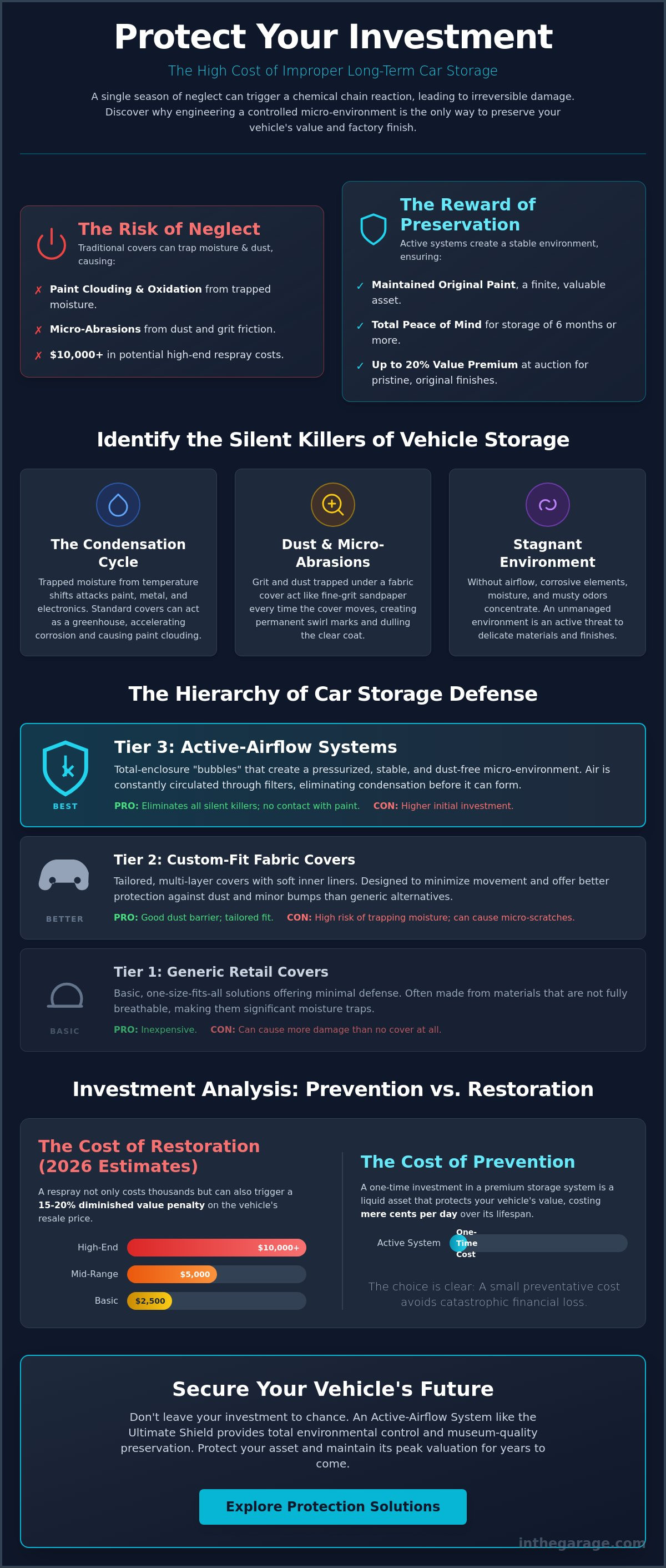
When you analyze the return on investment, the numbers favor prevention. A premium storage system with a 10-year lifespan costs mere cents per day, a negligible figure compared to the thousands required for paint restoration. While many enthusiasts utilize paint protection film technology for road use, an active storage environment provides the necessary defense when the car is at rest. You can contrast the high price of a professional respray with the predictable, one-time cost of a car shield cover. This system functions as a liquid asset; it preserves the vehicle's market price and prevents the 10% to 15% resale penalty often associated with cars lacking a documented history of climate-controlled storage. By investing in total protection now, you ensure the asset remains at peak valuation for years to come.
Evaluating the Hierarchy of Defense: Fabric Covers vs. Inflatable Shields
Selecting a long term car storage cover involves more than just picking a size. It requires a strategic choice between passive and active defense systems. We categorize vehicle protection into three distinct tiers:
- Generic Retail Covers: Basic one-size-fits-all solutions that offer minimal defense against environmental variables.
- Custom-Fit Fabric Shields: Tailored passive barriers designed for specific dimensions to minimize movement.
- Active-Airflow Systems: Pressurized environments that manage the atmosphere and eliminate surface contact.
Each level operates on the "sacrificial layer" theory. The cover is designed to absorb environmental impacts, such as UV radiation and airborne particulates, to spare the underlying finish. However, passive protection has significant limitations. In high-humidity environments, a standard cover often fails by becoming a moisture trap. This leads to paint clouding and oxidation that can't be easily corrected without professional intervention.
Traditional Fabric Covers: The Passive Approach
Traditional covers serve as a basic physical barrier. High-end indoor versions focus on soft, non-abrasive inner liners to prevent dust accumulation. Outdoor versions utilize multi-layered, UV-resistant textiles to repel water and sun damage. It's vital to prioritize breathability over being strictly waterproof. A completely waterproof cover often seals in rising ground moisture, creating a greenhouse effect that accelerates corrosion. Even with a custom-fit long term car storage cover, the risk of micro-scratches remains high. Every time the fabric is installed or removed, it creates friction. If any grit is trapped between the liner and the bodywork, it acts like sandpaper, dulling the factory shine over time.
Inflatable Storage Shields: The Active Solution
The active solution represents the pinnacle of vehicle preservation. Systems like the Showcase offer a touchless advantage that eliminates the friction risks associated with fabric. By avoiding direct contact with the paint, you remove the possibility of micro-abrasions entirely. These systems rely on constant air exchange. Filtered fans circulate air to ensure that relative humidity remains stable, effectively breaking the condensation cycle that plagues unmanaged garages. The inflatable garage has emerged as the ultimate evolution in this category. It creates a pristine, pressurized environment that protects against dust, pests, and moisture simultaneously. For owners who demand total peace of mind, transitioning to an active shield is the definitive choice for long-term security.
The Silent Killers of Paint: Humidity, Condensation, and Micro-Abrasions
A dry garage is a dangerous myth. Many owners believe that four walls and a roof are enough to protect their investment, but the environment inside a standard garage is often more hostile than it appears. The "Big Three" storage threats, moisture, particulates, and pests, operate silently. They don't require a leak in the roof to cause thousands of dollars in damage. Professional car storage facilities maintain a relative humidity of 45-55% precisely because levels outside this range trigger the Condensation Cycle. When garage temperatures shift, warmer air meets the cold metal panels of your vehicle. Liquid water forms in hidden crevices and under the surface of your paint, leading to paint clouding. This is a chemical reaction where moisture becomes trapped within the clear coat, creating a permanent haze that usually requires a professional respray to fix. A high-quality long term car storage cover is your primary defense against this atmospheric decay.
- Moisture: Triggers oxidation on chrome and clouding in clear coats.
- Particulates: Micro-abrasives that scratch paint during cover shifts.
- Pests: Rodents that cause irreversible damage to wiring harnesses and interiors.
The Condensation Trap: Why Cheap Covers Destroy Paint
Cheap, non-breathable plastic covers are often worse than no cover at all. They create a localized greenhouse effect, sealing in ground moisture and rising humidity. This trapped vapor accelerates the oxidation of chrome and delicate electronics. If you've ever seen a car emerge from storage with pitted aluminum or cloudy headlights, you've seen the results of a failed barrier. In contrast, a specialized car cover for snow or long-term storage must prioritize moisture egress. It needs to allow the vehicle to breathe while still providing a robust physical shield. Without this airflow, you aren't protecting your car; you're essentially marinating it in humidity.
Dust as "Invisible Sandpaper"
Dust is never just dust. It is a collection of micro-abrasive particulates. In a static garage environment, static electricity actually attracts these particles to your car's surface. A traditional long term car storage cover can inadvertently become an abrasive tool. If the cover shifts due to air currents or during removal, it grinds these fine particulates into the clear coat. This creates a network of micro-scratches that dull the factory shine. The only way to truly eliminate this risk is through a filtered air approach. By creating a pressurized environment with constant, filtered airflow, you ensure that dust never has the opportunity to settle on the vehicle in the first place.
A Tiered Roadmap: Choosing Your Long-Term Storage Strategy
Selecting the appropriate long term car storage cover requires a cold assessment of your specific risks. We don't believe in a one-size-fits-all approach. Instead, we advocate for a decision framework based on three critical factors: the storage environment, the duration of the layup, and the vehicle's market value. A classic stored in a damp barn for three years requires a vastly different strategy than a modern sports car sitting in a suburban garage for the winter. You must match the intensity of the protection to the severity of the threat.
- Scenario A: The Short-Term Indoor Layup. Focused primarily on dust protection and preventing minor surface contact during one to three month intervals.
- Scenario B: The Seasonal Outdoor Storage. Designed to combat UV radiation, extreme temperature swings, and heavy precipitation over three to six months.
- Scenario C: The Multi-Year Museum Preservation. The gold standard for high-value assets, focusing on total environment control to halt all chemical decay.
The Indoor Preservation Strategy
For vehicles kept in private garages, we recommend following a strict indoor car cover hierarchy. Before applying any shield, you must execute the "Showroom Shine" checklist. This involves a thorough wash and decontamination, complete drying of all crevices, and tire-prep to prevent flat-spotting. Our Indoor Shield - Car is the preferred choice for cars that rarely move. It provides a breathable yet impenetrable barrier against garage dust and household pests. It ensures that when you finally peel back the cover, the paint remains as pristine as the day it was stored.
The Rugged Outdoor Defense
Outdoor storage demands a more aggressive posture. A true long term car storage cover for exterior use must feature a multi-layer construction. This includes a UV-reflective outer shell to prevent interior trim cracking and a soft inner lining to protect the clear coat. Security is equally vital. Integrated tie-down systems are essential to prevent "buffeting," where high winds cause the cover to flap and mar the paint. Our Outdoor Shield - Car utilizes advanced UV-inhibitors to stop paint fading before it starts. If you're ready to secure your vehicle against the elements, explore our professional-grade car shields today to find your definitive solution.
When relocating a vehicle to a specialized storage environment, utilizing a professional transport service like GAATCO provides the necessary security to ensure your asset arrives in pristine condition.
The Ultimate Shield: Total Environmental Control with In The Garage
In The Garage stands as the definitive choice for owners who refuse to compromise on vehicle safety. While traditional methods rely on passive barriers, we provide an engineered environment that actively halts decay. Investing in a long term car storage cover from our Ultimate Shield line means moving beyond simple dust protection. The Ultimate Shield - Car features a heavy-duty, puncture-resistant base constructed from laminated PVC. This base creates an impenetrable fortress against rising ground moisture, while the high-clarity canopy allows for constant visual inspection without breaking the pressurized seal. Our systems are tested and proven in the most demanding enthusiast garages, ensuring that your vehicle remains in a state of suspended animation, perfectly preserved against the elements.
Maintenance is designed to be effortless. The system utilizes a high-output fan that circulates filtered air every few minutes. This constant exchange ensures that the interior remains pristine and free of the micro-abrasives that typically settle on stationary cars. Because the air is filtered before it enters the canopy, the risk of "invisible sandpaper" is completely eliminated. It's a professional-grade solution that brings museum-quality preservation to your private collection.
The Showcase Advantage: Protection Meets Presentation
The Showcase - Car model represents the perfect intersection of aesthetics and security. It allows you to enjoy the visual appeal of your vehicle while it remains under total protection. Unlike zippered bags that require physical contact with the paint, the Showcase offers drive-in and drive-out convenience. There are no heavy fabrics to drag across your clear coat and no complex frames to assemble. For 24/7 reliability, these units include integrated fan systems and battery backups. If the main power fails, the system remains inflated, keeping your asset shielded from dust, pests, and accidental impacts without interruption.
Securing Your Investment Today
Defending Your Automotive Legacy
Preserving a vehicle's factory finish is a sophisticated challenge that requires more than a simple barrier. You've learned that the condensation cycle and micro-abrasions are relentless threats that demand an active, engineered response. By choosing a high-performance long term car storage cover, you aren't just hiding your car away. You're securing a potential 20% value premium and avoiding the staggering costs of a professional respray. It's a strategic move that separates casual owners from true collectors who prioritize long-term asset health.
In The Garage provides the definitive solution with over 30 years of automotive preservation expertise. Our systems utilize durable materials tested for 24/7 active protection, a standard relied upon by world-class collectors and enthusiasts. Don't leave your car's future to chance in an unmanaged environment. Secure your vehicle’s future with an Ultimate Shield from In The Garage. It's time to enjoy the peace of mind that comes with total environmental control and museum-quality care. Your investment is ready for whatever the future holds.
Frequently Asked Questions
Is a breathable car cover better than a waterproof one for long-term storage?
Breathability is the superior choice for long-term preservation because it prevents moisture from becoming trapped against the panels. A strictly waterproof cover often acts as a vapor barrier, sealing in ground humidity and creating a corrosive greenhouse effect. For a high-performance long term car storage cover, look for materials that allow vapor to escape while repelling liquid water from the outside.
How much does it typically cost to professionally paint a car if the storage fails?
Professional respray costs vary significantly based on the desired finish quality. As of 2026, a basic paint job typically ranges from $1,000 to $2,500, while a mid-range, better quality respray generally costs between $3,000 and $5,000. For showroom quality that preserves an asset's value, owners should expect to pay between $6,000 and $10,000 or more to rectify the damage caused by improper storage.
Can an inflatable car storage cover prevent rust in a damp garage?
An inflatable shield effectively prevents rust by breaking the condensation cycle through constant air circulation. By maintaining a stable micro-environment, these systems prevent warmer air from meeting cold metal surfaces, which is the primary cause of liquid water formation. This active approach is the most reliable way to protect a vehicle's structural integrity in a damp or non-climate-controlled garage.
How often should I check on my car if it is in a long-term storage bubble?
You should perform a brief visual inspection of your vehicle at least once a month. The high-clarity canopy of systems like the Showcase allows you to check tire pressure or battery tender status without breaking the pressurized seal. This ensures the long term car storage cover is operating at peak efficiency while maintaining total environmental control throughout the layup.
Will a traditional fabric car cover scratch my paint over time?
Traditional fabric covers can cause micro-scratches through friction and trapped particulates. Even a clean-looking cover can act like sandpaper if fine dust is ground into the clear coat during installation or removal. Transitioning to a touchless, inflatable system eliminates this contact risk entirely, preserving the factory shine and preventing the need for aggressive paint correction later.
What is the best way to protect a car from sun damage if I store it outdoors?
The most effective outdoor protection involves a multi-layer shield equipped with advanced UV inhibitors. These materials reflect solar radiation to prevent paint fading and interior trim cracking over long periods. It's also vital to use a secure tie-down system to prevent the cover from buffeting in high winds, which is a common cause of physical surface marring in outdoor settings.
Do inflatable storage systems require a constant electricity connection?
Inflatable storage systems require a constant connection to power the filtered fan system that maintains the pressurized environment. This airflow is what ensures a moisture-free atmosphere and prevents dust from settling on the vehicle. For maximum reliability, premium units include integrated battery backups that keep the shield inflated and the asset protected during temporary power outages.
Can rodents get inside an In The Garage storage shield?
Rodents are unable to breach a properly sealed In The Garage storage shield. The heavy-duty PVC base is designed to be impenetrable, and the constant air pressure creates a physical barrier that discourages pests from attempting entry. This provides an essential layer of security for wiring harnesses and delicate interiors that are frequently targeted by rodents in standard storage settings.
Disclaimer
Please note some articles may have AI generated content