


That premium fabric cover you rely on could be the greatest threat to your vehicle's finish. In a high-activity workshop, fine abrasive dust does not just sit on top of traditional covers; it migrates through the weave and settles directly against your paint. When you slide that cover off, those trapped particulates act like sandpaper, leaving behind a map of micro-scratches that ruin a flawless detail. Finding a truly effective dust proof car cover for workshop environments requires moving beyond static fabrics that rest on the surface.
We know the frustration of uncovering a car only to find a layer of silt or trapped moisture. This guide explores the shift toward active vehicle protection in 2026. You'll discover how inflatable, active covers create a pressurized micro-environment that physically isolates your asset from the chaos of the shop. We will break down why total isolation is the only way to guarantee purity and how these proven systems provide the ultimate peace of mind for owners who refuse to compromise on quality.
Key Takeaways
- Understand why fine particulates like sawdust and metal shavings turn traditional fabric into an abrasive liability for your vehicle's paint.
- Learn why an active inflatable system is the only true dust proof car cover for workshop environments by creating a pressurized, zero-contact barrier.
- Discover how positive pressure technology maintains a clean micro-environment, preventing fine dust from ever reaching the vehicle surface.
- Identify the specific advantages of the Showcase and Indoor Shield models for different workshop layouts and storage requirements.
- Master the essential preparation steps to ensure your vehicle remains in a pristine, showroom state during high-activity periods in your shop.
The Invisible Threat: Why Workshop Dust Requires Specialized Protection
A workshop is a high-risk zone for any vehicle finish. Unlike a standard residential garage, a workspace is filled with aggressive airborne contaminants. We're talking about more than just house dust. Sawdust from carpentry, metal shavings from grinding, and fine drywall particulates from renovation projects create a cocktail of destruction. These particles are often jagged and microscopic. When they settle on a surface, they don't just sit there; they wait to be moved.
Many owners believe a standard fabric cover is the solution. It isn't. In fact, in a busy shop, a traditional cover can become a liability. This is known as the "Sandpaper Effect." When fine dust penetrates the weave of automotive textiles used in standard covers, it becomes trapped between the fabric and your paint. Any slight movement, such as a breeze from an open door or someone brushing past the car, causes the fabric to shift. That trapped grit then grinds into the clear coat, leaving behind a web of micro-scratches. You need a dedicated dust proof car cover for workshop use that eliminates this physical contact entirely, such as the active vehicle protection systems designed for total isolation.
Understanding Micron-Sized Particulates
Workshop dust is incredibly small. Many particulates are measured in microns, often far smaller than the gaps in even high-thread-count fabric weaves. Over time, these covers "breathe," drawing in fine silt that settles on the vehicle's panels. Static electricity further complicates the issue. The friction of air movement in a workshop often creates a static charge on the vehicle, effectively acting as a magnet for airborne debris. Once the dust is pulled through the fabric, it's locked against the paintwork. This makes a traditional "rest-on-paint" cover more dangerous than leaving the car uncovered in some scenarios. True protection requires a barrier that never touches the surface it's designed to protect.
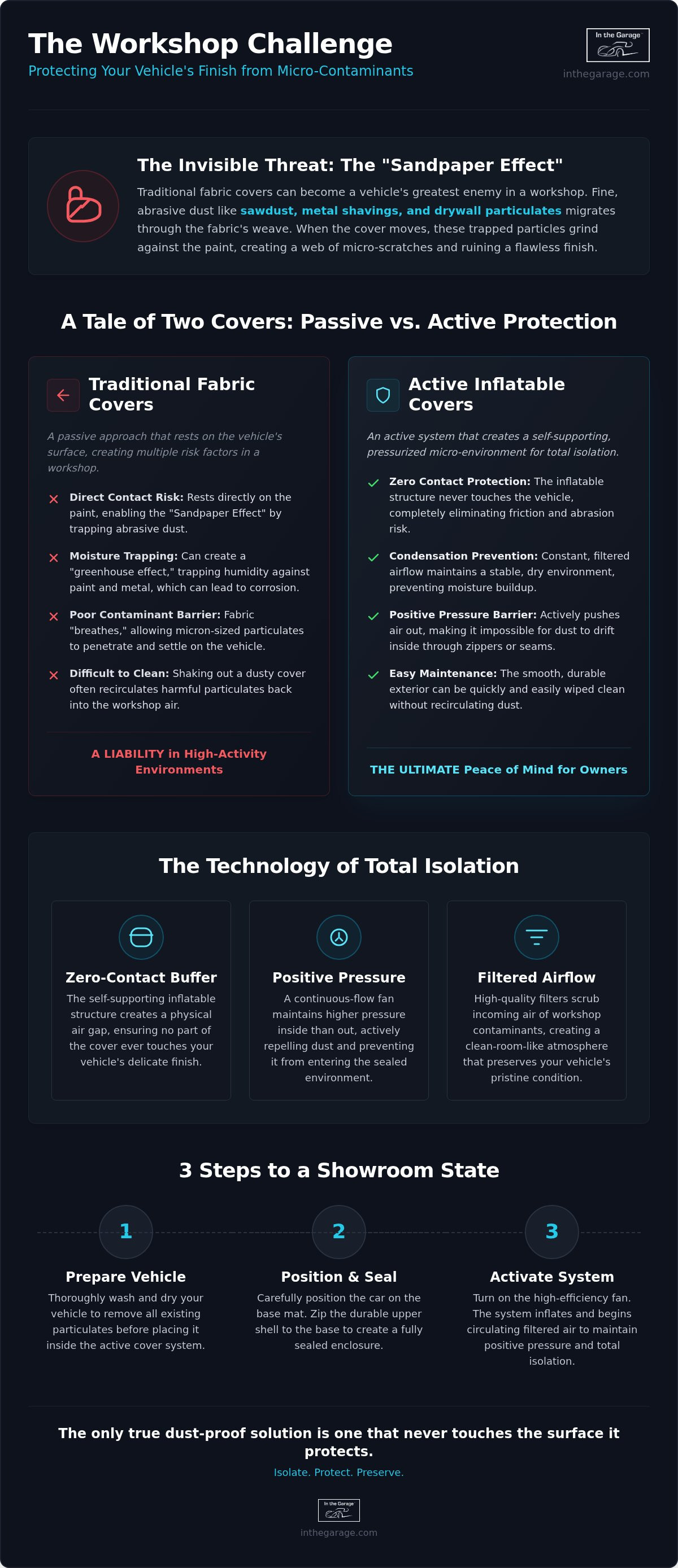
Active Inflatable Covers vs. Traditional Fabric: A Workshop Comparison
Traditional fabric covers are passive. They rely on the vehicle's body for support, which is a fundamental design flaw in a busy workspace. An active cover, by contrast, uses a continuous-flow inflatable system to create a rigid, self-supporting structure. This creates a physical buffer between the environment and the vehicle. Because the material never touches the paintwork, you eliminate the risk of friction scratches entirely. It's the only way to ensure a dust proof car cover for workshop environments actually protects the finish rather than endangering it.
Consider the maintenance reality. Cleaning a heavy, dusty fabric cover is a chore that often involves shaking out particulates back into your workspace. This just recirculates the problem. With an active system, the exterior is a smooth, durable surface. A quick wipe down is all it takes to maintain the barrier. Beyond dust, these systems solve the "greenhouse effect." Traditional covers can trap humidity against the metal, leading to corrosion during long-term storage. Active systems utilize constant airflow to prevent condensation, keeping the vehicle in a stable, dry micro-environment. Owners looking for this level of care can explore the full range of active vehicle protection options.
The Power of Positive Pressure
The secret to total isolation lies in the fan system. These units don't just inflate the structure; they maintain constant positive pressure. This means air is always being pushed out of the shield, making it physically impossible for dust to drift inside through zippers or seams. High-quality filtration ensures that every cubic inch of air entering the bubble is scrubbed of workshop contaminants before it reaches your car. The Indoor Shield is a prime example of this technology in action. It effectively transforms a corner of a busy shop into a clean-room environment. This active approach is tested and proven to maintain a showroom shine regardless of the work happening just inches away.
Setting Up Your Workshop Shield for Total Peace of Mind
Implementing a professional-grade barrier requires more than just unboxing the system. To ensure your vehicle remains in a pristine, showroom state, you must follow a methodical setup process. It begins with a thorough cleaning. Never place a vehicle into an active environment if it's already carrying workshop silt. Even the most advanced dust proof car cover for workshop use cannot protect paint from grit that's already trapped against the surface. Wash and dry the car completely to remove any existing particulates before sealing the system.
Once the vehicle is clean and positioned, focus on the infrastructure of your workspace. Managing the power supply for the active airflow system is vital in a busy shop. Route cables away from high-traffic zones or use cord protectors to prevent accidental unplugging or trip hazards. The continuous flow of air is what maintains the pressurized seal. You'll also need to establish a routine for filtration checks. In shops with high sawdust or metal grinding output, the intake filters work harder. Inspecting them every few weeks ensures the positive pressure remains at peak performance, keeping the interior environment truly isolated from the chaos outside.
Choosing Between the Indoor Shield and Showcase Models
Selecting the right configuration depends on how you use your space. For enthusiasts who want to admire their vehicle while working on other projects, the Showcase is the definitive choice. Its high-grade, crystal-clear PVC panels offer a 360-degree view, effectively turning your storage into a display. If your priority is purely long-term isolation in a more rugged garage environment, the Indoor Shield provides a heavy-duty, opaque barrier designed for maximum durability. These active covers are built to withstand the rigors of a working shop while maintaining a delicate micro-environment inside. For those seeking deeper technical specifications on material science and filtration, our Pillar Guide on Indoor Protection offers a comprehensive breakdown of these proven systems.
Secure a Pristine Finish in Any Environment
Traditional fabric covers simply cannot compete with the aggressive particulates found in a modern workspace. By switching to an active inflatable system, you eliminate the friction damage caused by trapped grit and prevent the moisture buildup that leads to corrosion. These systems create a pressurized sanctuary, ensuring your vehicle remains isolated from sawdust, metal shavings, and drywall debris. It's the definitive choice for those who demand a true dust proof car cover for workshop environments where standard textiles fail.
Our technology is precision-engineered for 2026 vehicle standards and is already trusted by professional restorers and collectors worldwide. These shields are tested to withstand the rigors of heavy workshop environments, providing a level of security that passive methods can't match. Don't let your hard work be undone by invisible airborne threats. Explore the full range of Active Inflatable Shields at In The Garage and find the perfect model to preserve your asset's showroom shine. Your investment deserves the peace of mind that only total isolation can provide.
Frequently Asked Questions
Is an inflatable car cover better than a traditional fabric cover for a workshop?
Yes, an active inflatable cover is superior because it eliminates surface contact entirely. Traditional fabrics rest directly on the paint, trapping abrasive workshop dust that leads to micro-scratches. The active system creates a rigid buffer, ensuring nothing touches the finish. This makes it the most reliable dust proof car cover for workshop environments where particulates are a constant presence.
How do active car covers prevent dust from entering?
These systems utilize positive pressure and specialized filtration to maintain a sterile environment. A continuous-flow fan draws air through a filter, scrubbing it of contaminants before it enters the shield. Because the internal pressure is higher than the external atmosphere, air is constantly pushed out through the seams. This physical barrier prevents even the finest micron-sized dust from drifting inside.
Do inflatable car covers use a lot of electricity in the garage?
No, the power consumption is remarkably low. The fans are designed for 24/7 operation and typically draw about as much electricity as a standard household lightbulb. You can maintain a pristine, dust-free environment for your vehicle without seeing a significant impact on your monthly utility costs. It's an efficient, cost-effective solution for both short-term projects and long-term storage.
Can I use an active cover if my workshop gets very humid?
Yes, active covers are ideal for humid conditions. Unlike traditional fabric that can trap moisture against the metal, the constant airflow in an active system prevents condensation from forming. This continuous air exchange stabilizes the micro-environment around your vehicle. It keeps the surface dry and protected, effectively mitigating the risk of corrosion or mildew in damp workshop settings.
Disclaimer
Please note some articles may have AI generated content