

Der teuerste Fehler ist die Annahme, ein „100 % wasserdicht“-Label garantiere Sicherheit. Tatsächlich wirkt eine minderwertige wasserdichte Autoplane oft wie eine Feuchtigkeitsfalle, die die Luftfeuchtigkeit am Lack einschließt und Rost oder Schimmel begünstigt. Ein frustrierendes Paradoxon: Das Werkzeug, das Ihr Investment schützen soll, kann es durch Mikrokratzer und eingeschlossene Kondensation entwerten. Sie brauchen eine Lösung, die ein kontrolliertes Mikroklima bietet, nicht nur eine Plastikfolie.
Wir wissen, dass Ihr Hauptanliegen als engagierter Besitzer ein kompromissloser Umweltschutz ist. Dieser Leitfaden zeigt Ihnen, wie Sie einen professionellen Schutz wählen, der fortschrittliche, atmungsaktive Materialien nutzt, um Lackschäden zu verhindern und gleichzeitig auch bei den heftigsten Stürmen sicher verankert bleibt. Sie entdecken den entscheidenden Unterschied zwischen einfacher Wasserresistenz und der ausgefeilten Materialwissenschaft, die für echten Fahrzeugschutz erforderlich ist. Wir betrachten maßgeschneiderte Konstruktionen, die neueste Mehrschicht-Stofftechnologie und die spezifischen Merkmale, die Ihr Auto im Neuzustand erhalten, Ihnen absolute Sicherheit geben und den Wiederverkaufswert über Jahre schützen.
Wichtige Erkenntnisse
- Verstehen Sie das „Kondensationsparadoxon“. Lernen Sie, wie Sie eine wasserdichte Autoplane auswählen, die einen professionellen Schutz bietet, ohne schädliche Feuchtigkeit an Ihrem Lack einzuschließen.
- Entlarven Sie den Schicht-Mythos. Setzen Sie Priorität auf leistungsstarke, UV-stabilisierte Materialien, die robuste Zuverlässigkeit und Langlebigkeit bieten, statt nur auf reine Stoffdicke.
- Vermeiden Sie den „Schleifpapier-Effekt“. Erfahren Sie, wie präzise gefertigte Passformen auch bei starkem Wind sicher bleiben, um Klarlackabrieb und strukturelle Schäden zu verhindern.
- Beherrschen Sie wesentliche Wartungsprotokolle. Befolgen Sie die goldene Regel der Anwendung, um die Lebensdauer und den Schutz Ihres spezialisierten Schutzes zu maximieren.
- Entdecken Sie die Entwicklung der Pflege. Gehen Sie über passive Stoffbarrieren hinaus zu fortschrittlichen aktiven Mikro-Umgebungs-Speicherlösungen für den vollständigen Schutz Ihres Fahrzeugs.
Das Kondensationsparadoxon: Warum „100 % wasserdicht“ gefährlich sein kann
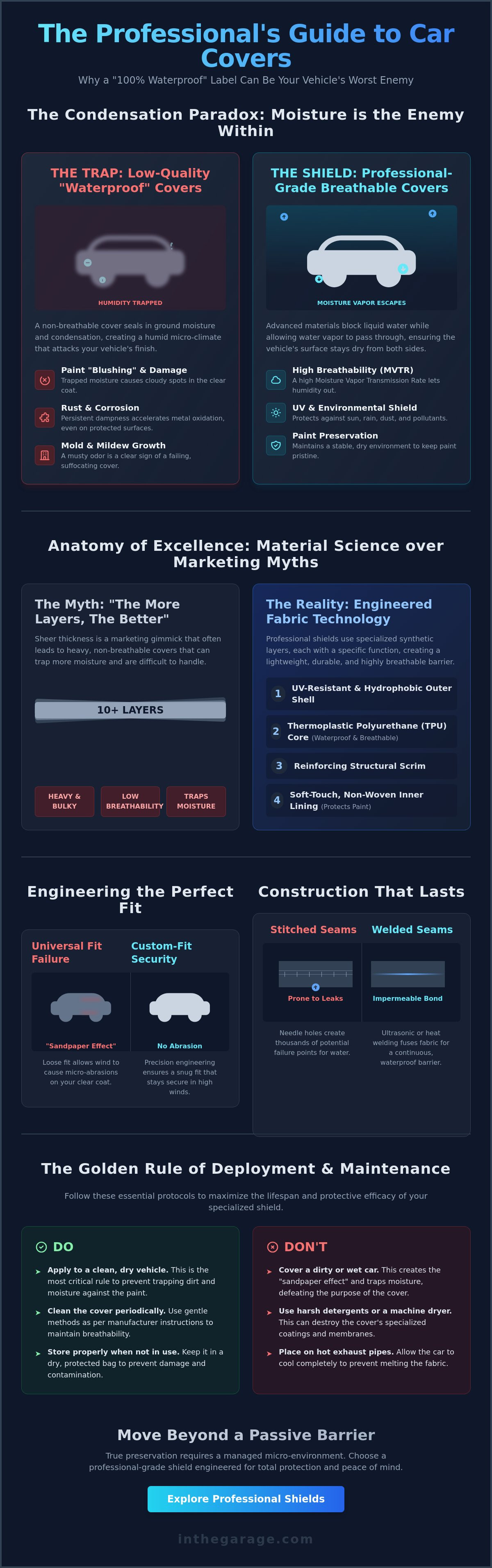
Totale Undurchlässigkeit klingt wie das ultimative Ziel für den Fahrzeugschutz. Für viele Besitzer ist es jedoch eine Falle. Das Kondensationsparadoxon tritt auf, wenn eine wasserdichte Autoabdeckung eine Einwegversiegelung schafft, die Regen blockiert, aber gleichzeitig verhindert, dass Bodenfeuchtigkeit entweicht. Wenn sich der Boden erwärmt, steigt die Feuchtigkeit vom Asphalt oder Boden unter Ihrem Fahrgestell auf. Ohne einen Ausweg wird diese Feuchtigkeit an der Fahrzeugoberfläche eingeschlossen und schafft ein feuchtes Mikroklima, das selbst an sonnigen Tagen gedeiht.
Diese eingeschlossene Feuchtigkeit löst eine schädliche chemische Reaktion mit modernen Klarlacken aus. Wenn Feuchtigkeit zwischen einem nicht atmungsaktiven Stoff und dem Lack komprimiert wird, kann es zu „Blushing“ kommen, das sich als trübe oder milchig-weiße Flecken tief im Finish zeigt. Es ist eine stille Bedrohung. Wenn Sie beim Abziehen des Stoffs einen muffigen Geruch bemerken oder anhaltendes Beschlagen der Fenster sehen, versagt Ihre Abdeckung. Während die Materialien für Fahrzeugabdeckungen oft eine hydrostatische Barriere priorisieren, um äußere Flüssigkeiten zu blockieren, müssen professionelle Schutzabdeckungen dies mit hoher Dampfdurchlässigkeit ausbalancieren, damit der Lack von beiden Seiten trocken bleibt.
Die Wissenschaft der eingeschlossenen Feuchtigkeit
Temperaturschwankungen verwandeln eine Standardabdeckung in ein Gewächshaus. Tagsüber erwärmt die Sonneneinstrahlung die Luft unter dem Stoff; nachts führt der Temperaturabfall dazu, dass sich die warme, feuchte Luft in flüssiges Wasser kondensiert. Dieser Zyklus wiederholt sich täglich und umgeht schließlich die natürlichen Schutzmechanismen des Lacks. Viele generische Atmungsaktivitätsbewertungen versagen in Küsten- oder Tropenregionen, da sie die hohe Umgebungsfeuchtigkeit nicht berücksichtigen. Eine wirklich professionelle Schutzabdeckung benötigt eine hohe Feuchtigkeitsdampfdurchlässigkeit (MVTR), die sicherstellt, dass gasförmige Wassermoleküle durch den Stoff entweichen können, selbst wenn flüssiger Regen am Eindringen gehindert wird.
Mikro-Umgebungsmanagement
Aktive Luftzirkulation ist die einzige endgültige Lösung für die langfristige Lagerung. Passive Stoffporen können leicht durch Staub oder Umweltverschmutzungen verstopfen und das Fahrzeug effektiv in eine feuchte Hülle einschließen. Hochwertige Designs integrieren strategisch platzierte Belüftungsklappen und interne Abstandshalter, die einen Schornsteineffekt fördern, frische Luft hereinziehen und feuchte Luft hinausdrücken. Um Ihre aktuelle Abdeckung zu testen, platzieren Sie ein Hygrometer für 24 Stunden im Fahrzeug. Wenn die Luftfeuchtigkeit unter der Abdeckung konstant höher ist als die Außenluft, erstickt Ihre Schutzabdeckung Ihre Investition, anstatt sie zu schützen. Echter Schutz erfordert ein kontrolliertes Umfeld, in dem die Luft niemals stagniert.
Anatomie der Exzellenz: Materialien, die professionelle Schutzabdeckungen definieren
Viele günstige Marken vermarkten „10-lagige“ Produkte als den Goldstandard für Schutz. Das ist eine Ablenkung. Tatsächlich führt reine Dicke oft zu einer schweren, unhandlichen Abdeckung, die nicht die notwendige Atmungsaktivität besitzt, um Ihren Lack zu schützen. Eine professionelle wasserdichte Autoplane setzt auf Materialintegrität statt auf Masse. Hochdichte, spezialisierte Kunststoffe übertreffen oft mehrlagige Alternativen, indem sie eine überlegene Dampfdurchlässigkeit und langfristige Haltbarkeit bieten. Es geht um die Konstruktion der Barriere, nicht um die Anzahl der übereinandergelegten Schichten. Der Fokus auf die Qualität jeder Komponente stellt sicher, dass Ihr Fahrzeug geschützt bleibt, ohne die Risiken schwerer, feuchtigkeitsbindender Stoffe.
Konstruktionsmethoden sind genauso entscheidend wie die Wahl des Gewebes. Traditionelle genähte Nähte erzeugen Tausende von Nadelstichlöchern, durch die Wasser unter Druck schließlich eindringt. Professionelle Abdeckungen verwenden wärmeversiegelte oder ultraschallgeschweißte Techniken. Diese Verfahren verschmelzen das Gewebe auf molekularer Ebene und schaffen eine durchgehende hydrostatische Barriere. In Kombination mit einem weich anfühlenden Innenfutter verhindern diese Materialien Mikroabrasionen, die entstehen, wenn der Wind die Abdeckung gegen den Klarlack bewegt. Für Besitzer, die bei der Materialwissenschaft keine Kompromisse eingehen wollen, bietet der Ultimate Shield die robuste Zuverlässigkeit, die für die anspruchsvollsten Umgebungen erforderlich ist.
Hochleistungs-Gewebetechnologie
Moderner Schutz basiert auf thermoplastischem Polyurethan (TPU). Dieses Material bietet die Flexibilität von Gummi mit der Stärke von hochwertigem Kunststoff und bildet den Kern einer effektiven wasserdichten Autoplane. Vliesstoffe sind die bevorzugte Wahl für die Innenschichten, da sie keine Richtungskörnung besitzen, die Schmutz oder Staub einschließen könnte. Beim Bewerten einer Abdeckung sollte man auf die Hydrostatik-Druckwerte achten. Ein Wert von 2.000 mm oder höher zeigt eine wirklich professionelle Barriere, die starken, anhaltenden Regengüssen standhält, ohne durchzulassen.
UV- und Wärmeschutz
Sonnenlicht ist genauso zerstörerisch wie Regen. UV-stabilisierte Außenschichten sind unerlässlich, um das Abblättern des Gewebes zu verhindern, ein Prozess, bei dem das Material spröde wird und zu Staub zerfällt. In extremen Wüstenklimata kann nicht stabilisiertes Polyester bereits nach nur sechs Monaten direkter Sonneneinstrahlung erhebliche strukturelle Schäden aufweisen. Reflektierende oder silberbeschichtete Oberflächen lenken thermische Energie aktiv ab, verhindern das Aufreißen von Innenleder und schützen die Armaturenbrett-Elektronik vor Hitzestau. Dunklere Abdeckungen können übermäßige Hitze absorbieren, was im Laufe der Zeit zur Verschlechterung empfindlicher Hightech-Sensoren und Batteriesysteme führen kann.
Die perfekte Passform entwickeln: Warum universelle Abdeckungen versagen
Eine lockere Passform ist mehr als ein ästhetisches Problem; sie ist ein strukturelles Versagen. Wenn eine wasserdichte Autoabdeckung nicht perfekt an Ihr Fahrzeug angepasst ist, lädt sie den „Schleifpapier-Effekt“ ein. Der Wind erfasst den überschüssigen Stoff, der dadurch vibriert und an der Klarlackschicht reibt. Mikroskopisch kleine Staubpartikel, die zwischen Abdeckung und Lack eingeschlossen sind, wirken als Schleifmittel und mattieren die Oberfläche mit der Zeit. Ein professioneller Schutz muss stationär bleiben, um wirksam zu sein. Er darf nicht flattern oder durchhängen, da Bewegung die Hauptursache für Oberflächenschäden bei langfristiger Lagerung ist.
Präzisionsengineering bestimmt auch, wie eine Abdeckung mit Vorsprüngen umgeht. Spiegeltaschen und Antennenpatches sind nicht nur Komfortmerkmale. Sie sorgen dafür, dass der Stoff über die gesamte Fläche gespannt bleibt. Ohne diese speziellen Schnitte dehnt sich das Material ungleichmäßig und es entstehen Lücken, durch die Wasser eindringen oder sich sammeln kann. Eine locker sitzende Abdeckung bildet zudem ein geschütztes „Zelt“, das Nagetiere anzieht. Diese Schädlinge suchen Unterschlupf im Motorraum und können dort Schäden in Höhe von mehreren Tausend Euro an der Elektrik verursachen. Eine sichere, flache Passform beseitigt diese Eintrittspunkte und bewahrt die mechanische Integrität Ihres Fahrzeugs ebenso wie die äußere.
Maßgeschneidert vs. Halbmaßgeschneidert vs. Universal
Universelle Abdeckungen folgen der Philosophie „eine Größe passt vielen“, was selten gelingt. Eine „Sedan Large“-Abdeckung hinterlässt oft überschüssiges Material auf dem Dach, wodurch sich Wasser ansammelt. Dieses stehende Wasser übt enormen Druck auf die Nähte aus und führt schließlich zu einem Riss. Halbmaßgeschneiderte Optionen bieten eine bessere Grundlage, aber nur fahrzeugspezifische Schnitte berücksichtigen moderne aerodynamische Formen. Für Enthusiasten, die eine kompromisslose Passform verlangen, bieten ein Outdoor Shield oder Ultimate Shield die exakte Geometrie, um die vollständige Integrität zu bewahren und die Ansammlung von starkem Regen in Vertiefungen zu verhindern.
Schutz Ihrer Investition vor Wind
Die Physik des „Abhebens“ kann eine Schutzschicht zur Schwachstelle machen. Starke Winde erzeugen einen Unterdruck, der die Abdeckung anhebt und dabei Kunststoffleisten abbrechen oder den Lack zerkratzen kann. Sie müssen das Sicherungssystem sorgfältig prüfen. Verstärktes Nylonband ist deutlich überlegen gegenüber spröden Kunststoffclips, die unter Spannung versagen. Ein beschwertes Unterteil oder ein umlaufender Kordelzug sorgt für eine echte Abdichtung zum Boden und verhindert, dass Luft darunter gelangt. Dieses Sicherheitsniveau stellt sicher, dass Ihr Fahrzeug auch bei den heftigsten Stürmen geschützt bleibt, ohne dass die Abdeckung zum Segel wird und sich selbst oder Ihr Auto beschädigt.
Installation und Wartung: Maximieren Sie die Lebensdauer Ihres Schutzes
Die Wirksamkeit einer wasserdichten Autoplane hängt untrennbar davon ab, wie sie angebracht wird. Sie müssen die goldene Regel des Fahrzeugschutzes befolgen: Decken Sie niemals ein schmutziges Auto ab. Wenn Sie eine Plane über Staub, Straßensalz oder Umweltschmutz spannen, versiegeln Sie abrasive Partikel gegen Ihren Klarlack. Da eine professionelle wasserdichte Barriere undurchlässig ist, lässt sie diese Partikel nicht von der Oberfläche wegwandern. Stattdessen werden sie eingeschlossen, was das Risiko von Oberflächenbeschädigungen bei Wind deutlich erhöht. Sauberkeit ist die Grundlage für vollständigen Schutz.
Die richtige Installationstechnik ist ein Zeichen echter Begeisterung. Vermeiden Sie den häufigen Fehler, den Stoff über den Asphalt zu ziehen, wo er Fett oder scharfen Kies aufnehmen kann. Legen Sie stattdessen die gefaltete Plane in die Mitte des Dachs und rollen Sie sie zu den vorderen und hinteren Stoßfängern aus. Diese methodische Vorgehensweise sorgt dafür, dass das weiche Innenfutter nur die Fahrzeugoberfläche berührt und so die Integrität von Lack und Schutz bewahrt. Beim Entfernen der Plane falten Sie die Seiten zur Mitte, um zu verhindern, dass äußere Verunreinigungen das Innenfutter verschmutzen.
Die Pflege der hydrostatischen Barriere erfordert eine spezielle Behandlung. Harte Haushaltsreiniger oder Bleichmittel entfernen chemisch die spezialisierten Beschichtungen, die Wasserabweisung und UV-Schutz bieten. Verwenden Sie nur sauberes Wasser und eine weiche Bürste für die routinemäßige Entfernung von Schmutz. Wenn eine intensivere Reinigung nötig ist, wählen Sie einen pH-neutralen Reiniger, der speziell für technische Stoffe entwickelt wurde. Für alle, die eine getestete, professionelle Lösung suchen, die jahrelangem intensiven Gebrauch standhält, empfehlen wir Outdoor Shield für ultimative Haltbarkeit.
Checkliste vor der Lagerung
Vor dem langfristigen Außenschutz sollte Ihr Fahrzeug eine gründliche Außenwäsche erhalten haben. Das vollständige Trocknen des Fahrzeugs ist der wichtigste Schritt. Jegliche Feuchtigkeit auf der Karosserie wird durch die wasserdichte Autoplane eingeschlossen, was zum schädlichen Kondensationsparadoxon führt. Überprüfen Sie die Karosserie auf scharfe Verzierungen oder Nachrüstungen, die den Stoff durchstechen könnten. Ein einziger Riss gefährdet das gesamte unter Druck stehende Mikroklima, das Sie geschaffen haben, und lässt flüssiges Wasser die Barriere umgehen.
Reinigung und Reparatur
Behandeln Sie Vogelkot und Baumharz sofort. Diese sauren Substanzen können UV-stabilisierte Beschichtungen angreifen, wenn sie in der Sonne austrocknen. Verwenden Sie ein feuchtes Mikrofasertuch für die Fleckenreinigung, anstatt aggressiv zu schrubben. Wenn der Stoff nach jahrelangem Gebrauch seine Wasserabweisung verliert, können Sie eine professionelle Durable Water Repellent (DWR)-Behandlung auf die Außenschale erneut auftragen. Für kleinere Löcher verwenden Sie einen speziellen Klebepatch, um die Integrität des wasserdichten Systems wiederherzustellen und das Eindringen von Feuchtigkeit zu verhindern.
Jenseits des Stoffs: Der professionelle Standard von In The Garage
Ein hochwertiges Fahrzeug zu schützen bedeutet mehr, als nur den Regen abzuhalten. Es geht darum, ein spezialisiertes Mikroklima zu steuern. Bei In The Garage folgt unsere „Premium Guardian“-Philosophie dem Grundsatz, dass jedes von uns verkaufte Produkt unter realen, anspruchsvollen Bedingungen getestet werden muss. Wir verstehen, dass ein Auto für unsere Community von Enthusiasten sowohl eine emotionale als auch eine finanzielle Investition ist. Dieses Qualitätsversprechen ist der Grund, warum unsere Lösungen die vertrauenswürdige Wahl für diejenigen sind, die sich nicht mit „gut genug“ zufriedengeben. Unser Ansatz basiert auf der Überzeugung, dass Schutz proaktiv sein sollte. Wir reagieren nicht nur auf das Wetter, sondern antizipieren die langfristigen Auswirkungen von Feuchtigkeit, UV-Strahlung und Umweltverschmutzung auf den Lack Ihres Fahrzeugs. Ob Sie eine leistungsstarke wasserdichte Autohülle für den Alltagswagen oder eine ausgeklügelte Lagerlösung für einen Klassiker benötigen – unsere Standards bleiben kompromisslos.
Der Vorteil des Ultimate Shield
Der Ultimate Shield ist unsere Spitzenlösung für extreme Außenbedingungen. Er verwendet eine ausgeklügelte Materialmischung, die hydrostatische Festigkeit mit notwendiger Atmungsaktivität ausbalanciert, sodass Feuchtigkeit niemals auf Ihrem Lack eingeschlossen bleibt. Einer der meist übersehenen Aspekte bei der Fahrzeuglagerung ist die Gefahr durch Schädlinge. Generische Abdeckungen haben oft lose Säume, die Nagetiere dazu einladen, im Motorraum Unterschlupf zu suchen, wo sie erhebliche elektrische Schäden verursachen können. Unser Design beseitigt diese Schwachstelle durch eine präzisionsgefertigte Passform, die den Umfang abdichtet. Dieser robuste Schutz stellt sicher, dass weder Feuchtigkeit noch Schädlinge die Integrität Ihres Fahrzeugs gefährden können. Entdecken Sie den Outdoor Shield - Car, um zu erfahren, wie sorgfältiges Design die häufigen Mängel herkömmlicher Stoffbarrieren verhindert.
Aktiver Schutz: Das Showcase-Modell
Für das ultimative Maß an Erhaltung gehen wir über passive Stoffabdeckungen hinaus. Die Showcase stellt die nächste Entwicklungsstufe in der Fahrzeugpflege dar und wandelt sich von einem einfachen Schutzschild zu einem aktiven Aufbewahrungssystem. Dieses aufblasbare Gehäuse schafft eine Umgebung, in der der Luftstrom konstant und kontrolliert ist. Durch den Einsatz eines Hochleistungsventilators, der gefilterte Luft zirkuliert, eliminiert die Showcase jegliche Möglichkeit von Feuchtigkeitsansammlungen und Kondensation vollständig. Es ist ein aktiver Schutzschild gegen Schimmel, Rost und Staub. Dieses System ist speziell für hochwertige Fahrzeuge konzipiert, die eine stabile, saubere und trockene Umgebung benötigen, unabhängig von den Bedingungen außerhalb des Gehäuses. Es bietet völlige Sicherheit für die anspruchsvollsten Besitzer, die den höchsten Pflegeanspruch an ihr Eigentum stellen. Sichern Sie Ihr Fahrzeug noch heute mit dem ultimativen Schutz.
Sichern Sie Ihr Erbe mit professioneller Erhaltung in Spitzenqualität
Echter Fahrzeugschutz erfordert mehr als eine einfache Barriere; er verlangt ein ausgeklügeltes Verständnis von Materialwissenschaft und Mikroklimamanagement. Sie wissen jetzt, dass eine hochwertige wasserdichte Autoplane die Dampfdurchlässigkeit priorisieren muss, um das zerstörerische Kondensationsparadoxon zu vermeiden. Präzise Passform ist kein Luxus, sondern eine Notwendigkeit, um Klarlackabrieb zu verhindern und Schädlinge vom Motorraum fernzuhalten. Durch Fokus auf Materialintegrität und sorgfältige Pflege stellen Sie sicher, dass Ihre Investition unabhängig von der Jahreszeit im Ausstellungszustand bleibt.
In The Garage bringt über 30 Jahre Erfahrung von Autoenthusiasten in jede von uns entwickelte Abdeckung ein. Unsere Lösungen sind für extremen Umweltschutz konzipiert und werden von hochwertigen Fahrzeugsammlern weltweit vertraut. Wir glauben nicht an Kompromisse. Wir glauben daran, durch getestete, bewährte Technologie ultimative Sicherheit zu bieten. Überlassen Sie die Zukunft Ihres Autos nicht dem Zufall mit generischen Alternativen, die versagen, wenn die Elemente am schlimmsten sind. Investieren Sie in den Rundumschutz mit In The Garage Shields und geben Sie Ihrem Fahrzeug den Premium-Schutz, den es verdient. Ihr Engagement für Exzellenz beginnt heute mit der richtigen Wahl.
Häufig gestellte Fragen
Kann eine wasserdichte Autoplane meinen Lack zerkratzen?
Eine wasserdichte Autoplane selbst zerkratzt Ihren Lack nicht, aber eingeschlossene Verschmutzungen oder eine schlechte Passform können das durchaus tun. Wenn der Wind eine lose Abdeckung zum Vibrieren bringt, wirkt jeder Staub auf der Fahrzeugoberfläche als Schleifmittel. Sie müssen sicherstellen, dass das Auto vor dem Auflegen sauber ist, und eine Abdeckung mit weicher Innenbeschichtung wählen, um die Klarlackintegrität zu erhalten und Mikrokratzer zu vermeiden.
Wie verhindere ich, dass unter meiner Autoplane Schimmel wächst?
Um Schimmel zu verhindern, muss das Mikroklima durch hohe Dampfdurchlässigkeit und aktive Belüftung kontrolliert werden. Sie sollten eine Abdeckung wählen, die mit atmungsaktiven Stoffen und integrierten Luftöffnungen ausgestattet ist, damit aufsteigende Bodenfeuchtigkeit entweichen kann. Stagnierende Feuchtigkeit ist der Hauptauslöser für Pilzwachstum; daher ist ständiger Luftstrom Ihr stärkster Schutz gegen Schimmel und Mehltau bei langfristiger Lagerung.
Ist es in Ordnung, eine Autoplane auf ein nasses Auto zu legen?
Sie sollten niemals eine Abdeckung auf ein nasses Fahrzeug aufbringen. Das Platzieren einer wasserdichten Barriere über stehendem Wasser versiegelt diese Feuchtigkeit gegen den Lack, was oft zu Bläschenbildung oder milchig-weißen Flecken im Klarlack führt. Trocknen Sie das Auto immer vollständig mit einem sauberen Mikrofasertuch, um sicherzustellen, dass die Oberfläche frei von Feuchtigkeit ist, bevor Sie Ihren Schutzschild für die Saison anbringen.
Wie lange hält eine hochwertige wasserdichte Autoplane?
Eine professionelle wasserdichte Autoplane bietet unter normalen Bedingungen typischerweise drei bis fünf Jahre zuverlässigen Schutz. Die Lebensdauer hängt stark von der Intensität der UV-Bestrahlung und Ihrer Wartungsroutine ab. Abdeckungen mit UV-stabilisierten Außenschichten und wärmeversiegelten Nähten behalten ihre hydrostatische Integrität deutlich länger als günstige Alternativen aus nicht stabilisierten Stoffen, die mit der Zeit spröde werden und abblättern.
Was ist der Unterschied zwischen wasserabweisenden und wasserdichten Abdeckungen?
Wasserabweisende Stoffe sind so konzipiert, dass sie leichte Feuchtigkeit abperlen und abweisen, aber sie sättigen sich bei anhaltendem Starkregen schließlich. Im Gegensatz dazu verwendet eine echte wasserdichte Abdeckung eine spezielle Membran, die eine vollständige hydrostatische Barriere bildet. Während wasserdichte Optionen überlegenen Flüssigkeitsschutz bieten, müssen sie mit hoher Atmungsaktivität kombiniert werden, um die Ansammlung von Feuchtigkeit und aufsteigendem Bodendampf im Inneren zu verhindern.
Kann ich eine wasserdichte Outdoor-Abdeckung für die Lagerung im Innenraum verwenden?
Sie können eine Outdoor-Abdeckung auch drinnen verwenden, aber das ist nicht immer die effizienteste Wahl. Outdoor-Materialien sind für robusten Umweltschutz und UV-Beständigkeit konzipiert, wodurch sie schwerer und möglicherweise weniger atmungsaktiv sind als spezialisierte Innenraumstoffe. Für die Lagerung in der Garage bietet eine spezielle Indoor-Abdeckung überlegenen Staubschutz und maximale Dampfabfuhr, was für die Erhaltung in kontrollierten Umgebungen oft vorzuziehen ist.
Wie verhindere ich, dass meine Autoplane bei starkem Wind weggeweht wird?
Um Ihre Abdeckung gegen starken Wind zu sichern, ist eine präzise Passform und verstärkte Befestigungspunkte erforderlich. Sie sollten strapazierfähige Nylon-Gurtbänder und Windschutzvorrichtungen verwenden, anstatt sich nur auf elastische Säume zu verlassen. Ein beschwertes Perimeter oder ein Kordelzugsystem schafft eine feste Abdichtung gegen die Unterseite des Fahrzeugs und verhindert den Auftriebseffekt, der Wind unter das Gewebe gelangen und es anheben lässt.
Sind 10-lagige Autoplanen tatsächlich besser als 3-lagige?
Die Anzahl der Schichten ist oft eine irreführende Marketingkennzahl. Ein leistungsstarkes 3-lagiges Schutzschild mit fortschrittlichen Membranen bietet häufig besseren Schutz und Atmungsaktivität als eine sperrige 10-lagige Abdeckung aus minderwertigen Materialien. Zu viele Schichten fügen unnötiges Gewicht hinzu und können tatsächlich mehr Wärme und Feuchtigkeit einschließen, was genau die Vorteile beeinträchtigt, die Sie durch spezialisierte Autopflege schützen möchten.