


The traditional car cover you rely on to protect your investment is often the primary source of the micro-scratches and swirl marks currently dulling your vehicle's finish. It's a frustrating reality for any enthusiast. You invest countless hours into detailing, yet dust accumulation and humidity-induced oxidation still find a way to compromise the paintwork while the car sits in the garage.
Maintaining a pristine surface requires a shift in strategy. This guide introduces a professional-grade checklist for car paint protection for storage that combines advanced chemical shields with active, non-contact physical protection. You'll learn how to master the essential steps to safeguard your vehicle's finish indefinitely. We'll examine how to eliminate environmental variables and why an active cover system is the definitive choice for those who refuse to settle for the limitations of a standard fabric wrap. By the end of this guide, you'll have the expertise to preserve your asset's resale value, which can be improved by up to 15 percent through meticulous care, ensuring its showroom shine remains untouched by time.
Key Takeaways
- Understand why deep decontamination and paint correction are mandatory first steps to ensure your chosen shield doesn't permanently lock in existing surface defects.
- Transition from traditional covers to an inflatable "active" cover system that provides a non-contact physical barrier, eliminating the risk of surface friction and swirl marks.
- Learn to manage the environmental variables in your garage by maintaining a stable relative humidity between 40-50% to prevent oxidation and dry-rot.
- Implement a high-performance strategy for car paint protection for storage that utilizes constant air exchange and filtered intake to keep your vehicle's finish pristine.
The Surface-Level Checklist: Preparing Your Paint for Long-Term Shielding
Excellence starts at the molecular level. Any effective car paint protection for storage protocol begins with a surface that is chemically and physically pure. Before you introduce any external barrier, you must ensure the underlying finish is pristine. Neglecting this foundational step means you're merely preserving the contaminants that will slowly degrade your clear coat over time.
Decontamination is your first priority. Use a high-quality clay bar and detailing solutions from SKY MAXPRO to extract brake dust, rail dust, and industrial fallout that a standard wash cannot reach. If these particulates remain, they act as microscopic abrasives that can cause damage during the storage cycle. Correction follows immediately after. Polishing is not just about aesthetics; it's about integrity. Any sealant or shield will effectively "lock in" the current state of your paint. Removing swirl marks now prevents them from becoming permanent features while the vehicle is inactive.
Chemical bonding creates your hydrophobic foundation. Apply a high-performance ceramic or sealant layer to repel the moisture that triggers oxidation. Finally, implement a strict drying protocol. Use forced air to clear every drop from crevices, ensuring no trapped water remains to cause corrosion or mold. This meticulous preparation ensures your vehicle is ready for the next phase of active preservation.
The Pre-Storage Cleaning Ritual
Verify the total removal of all organic contaminants. Bird droppings and tree sap contain acidic compounds that etch through clear coats if left undisturbed for months. Don't overlook the door jambs and fuel filler areas. These hidden zones often harbor moisture and dirt that can migrate to exterior panels, compromising the environment within your active cover. A truly clean vehicle is the only vehicle ready for long-term shielding.
Choosing Your Base Chemical Shield
Select a shield based on your specific paint type and storage goals. Carnauba wax offers a deep, warm glow favored by classic car enthusiasts, though it lacks the longevity of synthetic options. Modern SiO2 ceramic coatings provide superior durability and a high-gloss finish. While Paint protection film (PPF) provides the ultimate physical guard against impact, a ceramic base ensures total car paint protection for storage by sealing the pores of the paint. Choosing the right chemistry allows you to maximize the benefits of our specialized protection collections.
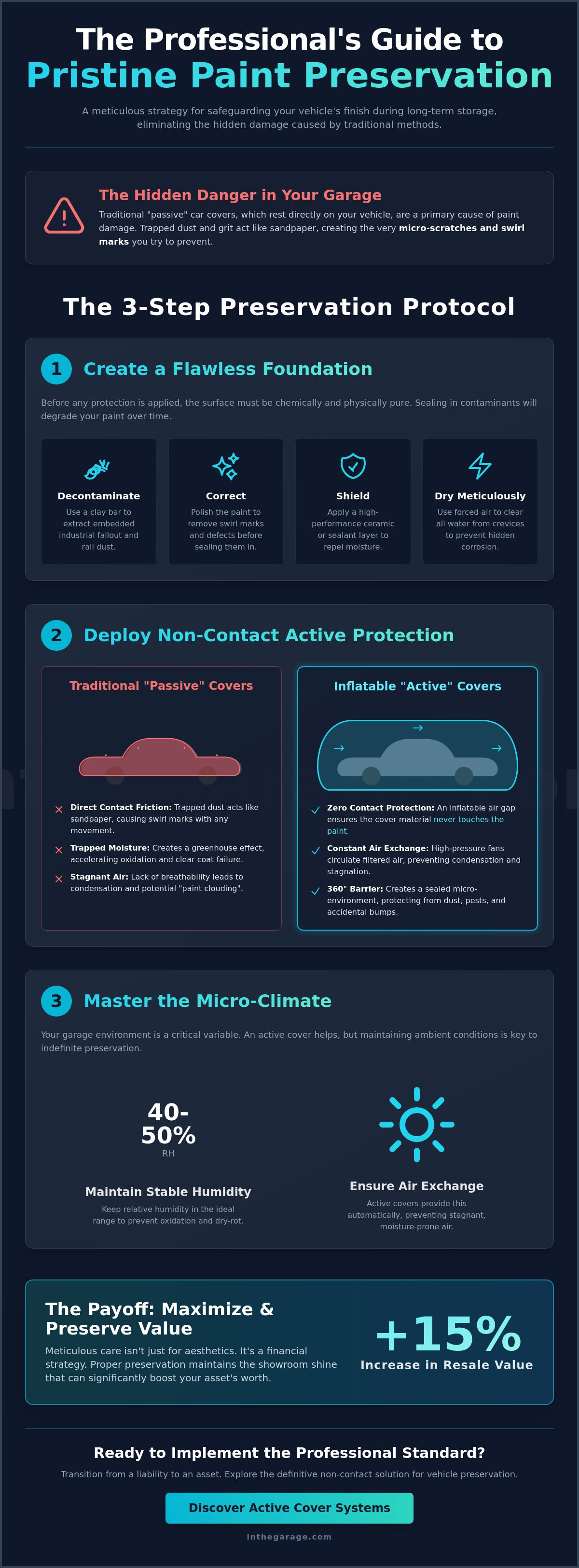
The Active Protection Checklist: Why Your Cover Shouldn’t Touch Your Paint
Chemical coatings and films provide a vital first layer, yet they cannot stop the physical degradation caused by environmental contact. This challenge of maintaining surface integrity is shared by other sectors; for instance, you can discover Seacoat SCT, LLC and their advanced, non-toxic marine hull coatings. For the car enthusiast, the next step in car paint protection for storage is eliminating the friction associated with traditional vehicle covers. While a standard cover may seem like a logical shield, its resting design is inherently flawed for long-term preservation.
Constant air exchange is equally critical. Stagnant air trapped under a standard fabric wrap often leads to condensation, which can cause "paint clouding" or osmosis bubbles in the finish. High-pressure fans within an active shield prevent this by ensuring a continuous flow of filtered air. Premium shields also offer material integrity through heavy-duty, UV-rated plastics, allowing for a transparent design. This lets you monitor your vehicle's condition without ever breaking the protective seal.
The Dangers of Traditional "Passive" Covers
Standard covers often do more harm than good. Beyond the sandpaper effect, they lack the breathability required for long-term preservation. Moisture becomes trapped against the paint, creating a greenhouse effect that accelerates oxidation and clear coat failure. If you value your finish, a resting cover is no longer a professional recommendation for high-value assets.
Implementing an Inflatable Active System
An inflatable active cover functions as a dedicated micro-environment, providing a superior level of car paint protection for storage compared to any passive alternative. By maintaining a secure perimeter seal, these systems provide 360-degree protection against dust, pests, and accidental garage bumps. This technology reflects The Rise of Inflatable Garages, moving vehicle care into a new era of active preservation. For those seeking the ultimate shield, exploring our specialized active covers is the definitive next step.
The Environmental Maintenance Checklist: Controlling the Micro-Climate
True preservation goes beyond the physical surface. While chemical shields and non-contact barriers are essential, the air surrounding your vehicle dictates the long-term health of your clear coat. Achieving total car paint protection for storage requires precise control over the micro-climate inside your active shield. Without this, even the most expensive ceramic coating remains vulnerable to atmospheric degradation.
Humidity calibration is your primary objective. Aim to maintain a stable relative humidity (RH) between 40 percent and 50 percent. This specific range is critical; it's high enough to prevent the dry-rot of rubber seals and tires, yet low enough to halt the oxidation process. Active airflow management supports this balance. By using filtered intake systems, you optimize car paint protection for storage by ensuring the air surrounding the paint is free of abrasive particulates and corrosive moisture. To maintain this environment, perform regular filter maintenance. Clean the intake fans on your active cover monthly to ensure optimal air pressure and flow remain consistent.
Combating Condensation and Oxidation
Temperature stability is vital for preventing the "greenhouse effect" found in standard storage units. Rapid temperature drops in a garage often lead to the dew point being reached, causing moisture to settle directly on the paint. This condensation is the precursor to rust and clouding. An active cover utilizes constant airflow to break the surface tension of the air, preventing moisture from ever settling. This dynamic movement ensures that the environment remains dry and stable, regardless of external weather shifts.
Long-Term Monitoring for Preservation
Effective storage isn't a "set and forget" process. Utilize clear-view panels to conduct regular visual inspections without exposing the car to the raw garage environment. This allows for a "Showroom Shine" verification, where you can check for any dust settlement or surface changes through the shield. For a deeper dive into these technical requirements, consult The Ultimate Guide to Indoor Car Cover Solutions. Maintaining these standards ensures your asset remains in concours condition. Explore our full range of preservation systems to finalize your storage strategy.
Secure Your Automotive Legacy Through Active Preservation
Preserving a vehicle's finish in 2026 requires more than a simple fabric drape. You've learned that total car paint protection for storage starts with meticulous surface decontamination and ends with a controlled micro-climate. By transitioning from traditional resting covers to an inflatable active cover, you eliminate the friction that causes micro-scratches while ensuring constant, filtered airflow. This professional-grade approach transforms your garage into a high-performance preservation environment that effectively halts the aging process.
Our systems are tested and proven by automotive enthusiasts with 30+ years of experience. We utilize durable, premium materials specifically engineered for long-term vehicle preservation. These specialized storage systems are trusted by collectors worldwide to maintain showroom standards indefinitely. Don't leave your investment to chance with inferior, passive methods that can trap moisture and damage your clear coat. You now have the checklist required to maintain a pristine asset. As you finalize your preservation plan, you can discover Flava Car Scents to ensure the interior of your vehicle remains as inviting as the day it was stored.
Explore Active Protection Collections at In The Garage and secure the ultimate shield for your vehicle today. Your commitment to excellence deserves a protection strategy that is equally uncompromising. Take the final step in professional asset preservation and enjoy the peace of mind that comes with total environmental control.
Frequently Asked Questions
Does an active car cover protect better than a ceramic coating?
An active car cover and a ceramic coating serve different, complementary roles in a professional preservation strategy. While a ceramic coating provides a chemical shield against light etching and oxidation, an active cover offers a physical, non-contact barrier that eliminates dust accumulation and accidental impacts. For the most comprehensive car paint protection for storage, enthusiasts use both to ensure the paint is sealed chemically and shielded environmentally.
Can traditional car covers scratch my paint?
Traditional vehicle covers are a leading cause of micro-scratches and swirl marks because they rest directly on the clear coat. When dust particles become trapped between the fabric and the paint, any movement of the cover or the air around it acts like fine-grit sandpaper. An inflatable active cover removes this risk entirely by using a pressurized air gap that prevents the material from ever touching the vehicle's surface.
How does an inflatable active cover prevent condensation?
Inflatable active covers utilize high-pressure fans to maintain a constant exchange of filtered air, which prevents the moisture buildup common in stagnant environments. By keeping the air in a state of continuous motion, the system breaks the surface tension that allows condensation to form on cold metal panels. This active airflow management is the only reliable way to eliminate the "greenhouse effect" that often leads to rust and paint clouding during long-term storage.
Is it safe to leave an active cover running 24/7?
It is both safe and necessary to keep an active cover running 24/7 to ensure your car paint protection for storage remains effective. These systems are engineered for continuous, long-term operation using high-efficiency fans that consume very little power while providing high-volume airflow. Constant operation is the only way to maintain the pressurized environment and filtered air required to keep your vehicle in showroom condition indefinitely.
Disclaimer
Please note some articles may have AI generated content