


A standard two car garage in 2026 now demands an average investment of $29,584, yet this steep price tag doesn't even account for the months of zoning hurdles or the risk of moisture trapped in a stagnant structure. You understand that your vehicle deserves a premium sanctuary, but the traditional construction route often feels like a slow, expensive compromise. It's frustrating to wait on contractors while your investment sits exposed to the elements. We're here to show you how to achieve professional-grade vehicle preservation without the high cost, permits, or construction delays. You'll discover the most sophisticated alternatives to building a garage, specifically focusing on the inflatable "active" cover. Unlike traditional covers that rest on your paint, these dynamic systems create a pressurized, filtered environment. We will explore how these portable solutions deliver total environmental control and preserve your vehicle's resale value with zero permanent foundation required.
Key Takeaways
- Identify why the rising construction costs and permitting barriers of 2026 make modern alternatives to building a garage a more efficient choice for immediate asset protection.
- Compare structural solutions like carports and modular sheds to understand their limitations in managing fine dust and internal humidity levels.
- Discover how an inflatable "active" cover uses a pressurized air system to provide total environmental isolation without ever resting on your vehicle's delicate surface.
- Learn how to maintain your vehicle's resale value through continuous airflow and moisture displacement without the need for a permanent foundation or property tax increases.
Beyond the Foundation: Why Building a Traditional Garage Might Not Be Your Best Move
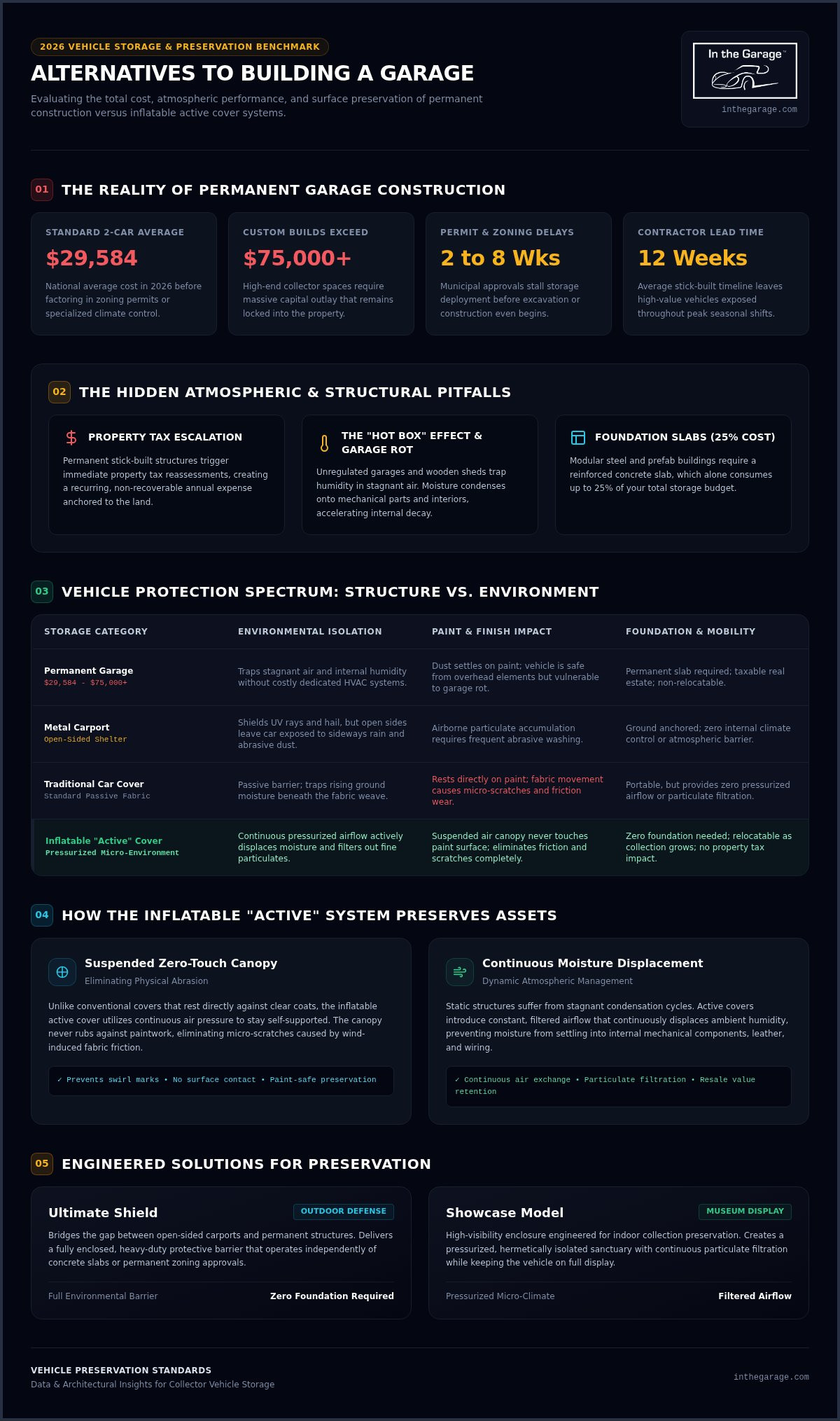
Constructing a residential garage in 2026 has become a significant financial hurdle. With national averages reaching $29,584, and custom builds often exceeding $75,000, many owners are questioning the return on investment. The financial strain is only the beginning. Municipal building permits and zoning approvals can delay your storage needs by two to eight weeks before a single shovel hits the dirt. These alternatives to building a garage have moved from niche products to essential solutions for collectors who value speed and efficiency.
Traditional structures often harbor a silent enemy: stagnant air. Without professional-grade climate control, a standard garage can become a "hot box" that traps humidity. This leads to "garage rot," a condition where moisture settles into mechanical components and delicate interiors. While freestanding and attached carports provide basic overhead shelter, they lack the total enclosure needed for true preservation. Non-permanent systems offer a versatile path. They allow you to relocate or expand your storage as your vehicle collection grows without being anchored to a fixed foundation.
The Hidden Costs of Permanent Construction
A permanent garage is a taxable asset that stays with the property. It often triggers a property tax reassessment, adding a recurring annual cost to your budget. Contractor lead times for stick-built structures currently average 12 weeks, leaving your vehicle exposed during the peak of the construction season. In contrast, sophisticated alternatives to building a garage offer an immediate solution. These high-performance systems provide the security of a controlled environment without the long-term liability of increased insurance premiums or permanent land alterations. You can explore a variety of these premium shields through our curated collections.
Evaluating Structural Alternatives: From Carports to Modular Sheds
When researching alternatives to building a garage, most enthusiasts first consider basic structural additions. Metal carports offer reliable shielding against UV rays and hail, yet their open-sided design leaves vehicles vulnerable to sideways rain and abrasive environmental dust. Given the high costs of building a traditional garage, these seem like a bargain. They don't, however, provide the total environmental isolation required for true preservation.
Enclosed alternatives to building a garage, such as Amish-style sheds or modular steel buildings, represent a step up in coverage. While aesthetically pleasing, wooden sheds often lack proper airflow, turning into "hot boxes" that trap humidity against your vehicle's clear coat. Steel modular units are exceptionally durable, but they still require a reinforced concrete slab. This foundation work alone can consume up to 25% of your total budget, adding significant hidden costs to the project.
Maximizing Protection with Semi-Permanent Structures
Deciding between an open carport and an enclosed modular unit depends on your local climate. If you face heavy snowfall or intense sun, overhead coverage is mandatory. However, these structures still fail to manage the vehicle's immediate environment. For those seeking rugged outdoor defense, the Ultimate Shield provides a definitive solution. Ultimate Shield models bridge the gap between carports and garages by offering a fully enclosed, high-performance barrier that doesn't require a permanent foundation. It's an uncompromising way to secure your investment while maintaining the flexibility of a portable system.
The Active Alternative: Achieving Total Preservation Without a Foundation
While structural shelters provide a roof, they fail to regulate the air surrounding your asset. The inflatable "active" cover represents the most sophisticated of all alternatives to building a garage. These systems create a pressurized micro-environment that actively filters out particulates. Unlike traditional car covers that rest directly on the clear coat, an active cover utilizes continuous air pressure to stay suspended. This eliminates the friction and micro-scratches caused by fabric movement, ensuring your paint remains pristine.
Many owners reviewing a carport versus garage comparison realize that neither option offers total isolation from moisture. The Showcase model solves this by providing a high-visibility, museum-quality display that doubles as a hermetically sealed sanctuary. It's the definitive choice for 2026, offering premium protection that moves with you.
Why Inflatable Active Systems Outperform Traditional Storage
The secret lies in the evaporative storage principle. These systems exchange internal air three to six times per hour. This constant displacement drives out humidity from wet tires or mechanicals, ensuring the dew point is never reached inside the bubble. You can achieve this professional-grade environment in minutes without a single tool, contractor, or building permit. It's a plug-and-play solution for the modern enthusiast.
For those seeking deeper technical insights into this technology, read about The Rise of Inflatable Garages. This shift toward active preservation ensures your vehicle remains in showroom condition regardless of the weather outside. It's a proven method to maintain resale value without the commitment of a permanent foundation.
Secure Your Investment with Modern Active Shielding
You've seen how the rising costs and regulatory delays of 2026 make traditional construction a burden. While carports and sheds provide basic overhead shelter, they can't match the environmental precision of an inflatable active system. By choosing these alternatives to building a garage, you're opting for a filtered, pressurized micro-environment that eliminates moisture and surface contact. We've spent 30 years perfecting specialized storage systems that are tested and proven in extreme environments. It's why collectors worldwide trust us to safeguard their most valuable assets. You don't need a permanent foundation to achieve ultimate vehicle preservation. It's time to experience the peace of mind that comes with professional-grade, active protection. Explore our collection of premium Active Shields and Showcase models to find the perfect fit for your collection today. Your vehicle deserves the best care available.
Expert Guidance on Vehicle Protection
Do I need a building permit for an inflatable active cover?
You don't need a building permit to install an inflatable active cover. Because these systems are non-permanent and portable, they fall outside the strict zoning regulations that govern traditional garages or carports. This allows you to deploy professional-grade protection immediately, bypassing the two to eight week municipal approval timelines that often delay structural projects. It's a seamless way to secure your vehicle without property tax reassessments.
How do active covers prevent condensation better than a traditional garage?
Active covers utilize a high-pressure fan system to exchange internal air three to six times per hour. This constant displacement ensures that moisture from tires or mechanical components is driven out before it reaches the dew point. Standard garages often trap stagnant, humid air, which leads to clear-coat clouding and rust. Our active systems maintain a stabilized micro-environment that traditional structures simply cannot match without expensive HVAC retrofitting.
Can I use an active inflatable cover for long-term winter storage?
Yes, our outdoor car bubbles are engineered specifically for long-term exposure to harsh winter elements. These systems use UV-stabilized, heavy-duty PVC shells and hot-air welded seams to withstand snow loads and freezing temperatures. By maintaining a pressurized isolation bubble, the active cover protects your vehicle from road salt, blowing snow, and nesting pests, ensuring it remains in showroom condition until the spring thaw.
What is the difference between an active cover and a traditional car cover?
The primary difference lies in surface contact and airflow. Traditional car covers rest directly on the vehicle's paint, trapping grit and moisture that cause friction hazing and swirl marks. In contrast, an active cover remains completely suspended off the painted panels using positive air pressure. This creates a protective barrier that never touches the clear coat, offering a superior solution among alternatives to building a garage.
Disclaimer
Please note some articles may have AI generated content