


Ist Ihre Garage wirklich das Heiligtum, für das Sie sie halten? Für die meisten Besitzer lautet die Antwort ernüchternd nein. Sie haben hart gearbeitet, um einen eigenen Platz für Ihr Fahrzeug zu sichern, und erwarten natürlich, dass es hinter verschlossenen Türen makellos bleibt. Es ist ein weit verbreiteter Glaube, dass die Innenlagerung das Ziel der Autopflege ist, doch die Realität ist ein ständiger Kampf gegen sich absetzenden Staub, versehentliche Dellen und die stille Bedrohung durch Kondensation. Ohne eine spezialisierte Indoor-Autogarage kann ein einfaches Dach nicht verhindern, dass Schädlinge im Motorraum nisten oder Mikrokratzer in schwer zugänglichen Ecken entstehen.
Dieser Leitfaden zeigt, warum atmosphärische Kontrolle und nicht nur Stoffdicke den ultimativen Standard in der Erhaltung definiert. Sie erfahren, wie Sie einen Schutz auswählen, der Ihre Lagerung von passiv zu proaktiv macht. Wir untersuchen die Wissenschaft hinter der Erhaltung von Ausstellungsstück-Perfektion und vergleichen die Präzision eines Indoor Shield - Car mit der fortschrittlichen, gefilterten Umgebung des Showcase - Car. Indem Sie die neuesten Trends in der Materialexzellenz für 2026 verstehen, können Sie sicherstellen, dass Ihre Investition so makellos bleibt wie am ersten Tag.
Wichtige Erkenntnisse
- Verstehen Sie, warum ein Standard-Garagendach mikroskopisch kleine Abriebpartikel nicht aufhält und wie eine hochwertige Indoor-Autogarage als präzise konstruierte Barriere gegen stille Umweltgefahren wirkt.
- Erfahren Sie die entscheidende Beziehung zwischen Atmungsaktivität des Stoffes und Feuchtigkeitsmanagement, um die „Kondensationsfalle“ zu vermeiden, die zu versteckter Korrosion führt.
- Erkunden Sie die Entwicklung der Fahrzeugerhaltung, vom traditionellen passiven Stoffschutz bis hin zu fortschrittlichen, berührungslosen Mikro-Umgebungen wie dem Showcase - Car.
- Beherrschen Sie das wesentliche Vorbereitungsprotokoll, einschließlich der Regel „Bedecke niemals ein schmutziges Auto“, um sicherzustellen, dass Ihre Schutzlösung den Lack verbessert und nicht beeinträchtigt.
- Erkennen Sie die spezifischen Kriterien für die Wahl zwischen dem autoritativen Indoor Shield - Car für die Standardlagerung oder dem Ultimate Shield - Car für Hochrisikoumgebungen.
Die verborgenen Gefahren der Garagenlagerung: Warum ein Dach nicht ausreicht
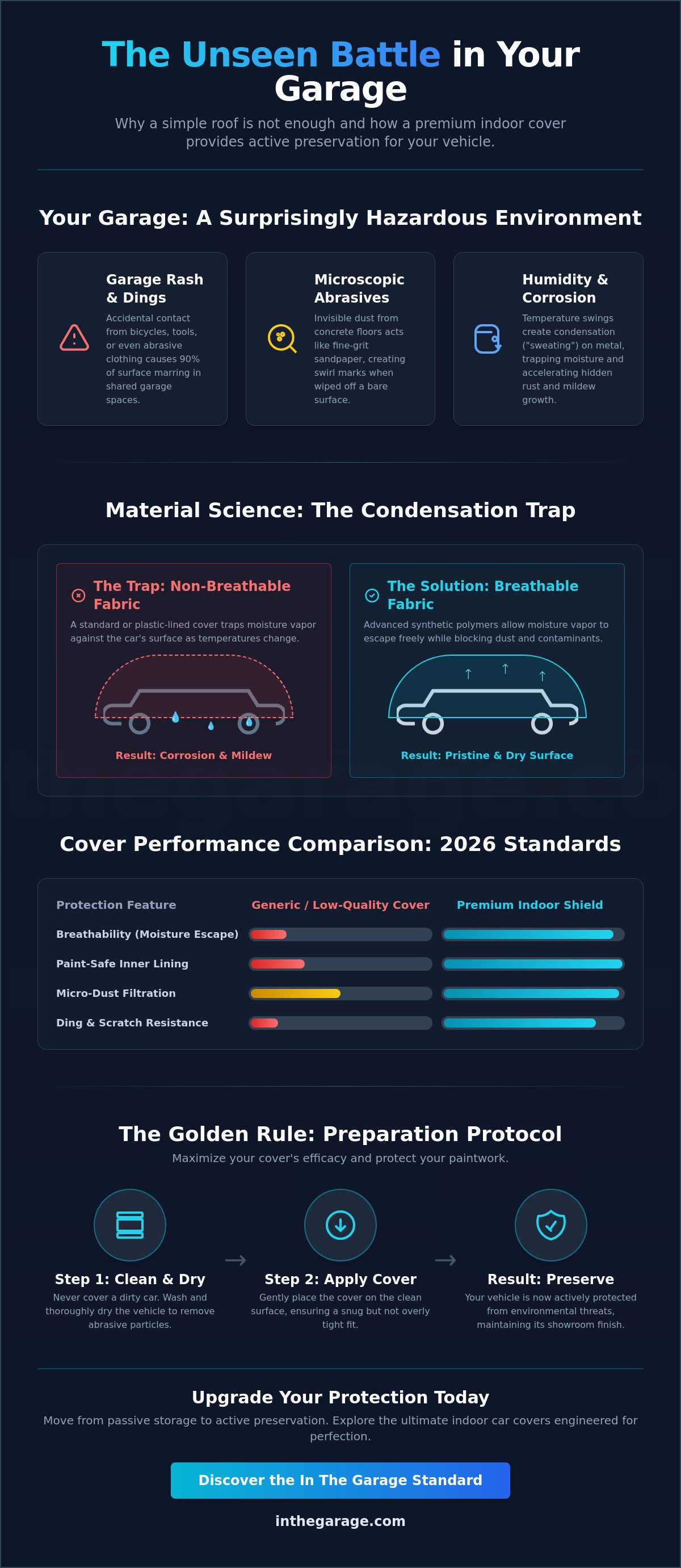
Viele Besitzer sehen die Wohn-Garage als einen statischen Tresor. Sie glauben, dass vier Wände und ein Dach vollständigen Schutz bieten. Das ist ein gefährliches Missverständnis. In Wirklichkeit ist eine Garage eine dynamische Umgebung, in der unsichtbare Gefahren ständig den Lack Ihres Fahrzeugs herausfordern. Eine hochwertige Indoor-Autogarage ist nicht nur ein Stück Stoff; sie ist eine präzise konstruierte Barriere, die speziell dafür entwickelt wurde, diese spezifischen Innenraumgefahren zu mindern. Es ist der Unterschied zwischen einfacher Lagerung und professioneller Erhaltung.
Es ist ein weit verbreiteter Irrglaube, dass das Auto sicher ist, sobald die Tür geschlossen ist. Das ist es nicht. Wir nennen die häufigste physische Bedrohung „Garagenkratzer“. Es passiert in einem Augenblick. Ein Fahrradlenker streift einen Kotflügel; eine fehlplatzierte Leiter lehnt an einer Tür; ein Passant streift mit abrasiver Kleidung über den Lack. Diese zufälligen Berührungen sind die Hauptursache für Oberflächenbeschädigungen in gemeinschaftlich genutzten Abstellräumen. Ohne einen speziellen Schutz ist Ihr Fahrzeug jeder Bewegung in Ihrem eigenen Zuhause ausgesetzt.
Mikropartikel und Lackabrieb
Selbst eine „saubere“ Garage ist voller luftgetragener Schadstoffe. Betonböden geben ständig feine Partikel ab. Diese Staubpartikel sind oft alkalisch, was mit der Zeit chemisch mit Klarlacken reagieren kann. Wenn Staub auf Ihrem Lack liegt, wirkt er wie mikroskopisches Sandpapier. Sobald Sie einen Schnellreiniger oder ein Mikrofasertuch verwenden, um das Auto „abzustauben“, schleifen Sie diese Partikel tatsächlich in den Lack ein. Ein einzelnes 10-Mikrometer-Staubpartikel, obwohl mit bloßem Auge unsichtbar, besitzt genug scharfe Kanten, um bei einer routinemäßigen Reinigung eine Lackoberfläche in Showqualität zu beschädigen.
Die Bedrohung durch Feuchtigkeit und Kondensation
Temperaturschwankungen sind der stille Feind von Metall. Die meisten Garagen sind keine wirklich klimatisierten Umgebungen. Wenn die Außentemperatur sinkt, kann die Luft im Inneren der Garage ihren Taupunkt erreichen. Dies verursacht „Schwitzen“ auf kalten Metalloberflächen, einschließlich Rahmenholmen, Bremsscheiben und Motorkomponenten. Diese eingeschlossene Feuchtigkeit beschleunigt die Korrosion an Stellen, die Sie nicht sehen können. Ohne eine atmungsaktive Indoor-Autogarageabdeckung bleibt diese Feuchtigkeit an der Oberfläche eingeschlossen und schafft einen Nährboden für Oxidation und Schimmel. Wahre Konservierung erfordert ein Material, das diese Dämpfe entweichen lässt und gleichzeitig äußere Verunreinigungen fernhält.
Materialwissenschaft: Atmungsaktivität, Weichheit und die Kondensationsfalle
Die Materialauswahl ist der Punkt, an dem Konservierungswissenschaft auf die physische Realität trifft. Die Wahl einer Indoor-Autogarageabdeckung erfordert mehr als nur eine einfache Beurteilung der Stoffdicke. Es verlangt ein Verständnis dafür, wie Textilien auf molekularer Ebene mit Autolacken interagieren. Eine Abdeckung, die zu schwer ist, kann unnötigen Druck auf hochstehende Karosserielinien ausüben, während eine zu dünne kaum Schutz gegen den zuvor erwähnten „Garagenkratzer“ bietet. Das Ziel ist eine ausgewogene Konstruktion, die strukturelle Integrität bietet, ohne den Lack zu beeinträchtigen.
Atmungsaktivität bleibt der wichtigste Faktor bei der Langzeitlagerung. Wenn eine Abdeckung keine hohe Feuchtigkeitsdampfdurchlässigkeit aufweist, entsteht eine „Kondensationsfalle“. Temperaturschwankungen führen dazu, dass die Luft unter der Abdeckung ihren Taupunkt erreicht, was zu Feuchtigkeitsansammlungen führt, die nicht entweichen können. Dies ist eine der häufigsten Lagerungsfallen und führt oft zu trüben Klarlacken oder Oxidation an freiliegendem Metall. Moderne synthetische Polymere haben traditionelle Baumwollflanellstoffe weitgehend übertroffen, da sie eine überlegene Feuchtigkeitsableitung bieten und gleichzeitig eine dichtere Webart haben, um mikroskopischen Staub zu blockieren.
Das Innenfutter ist der primäre Kontaktpunkt Ihres Fahrzeugs. Es muss nicht abrasiv und chemisch inert sein. Hochwertige Abdeckungen verwenden oft ein geschorenes Fleece oder ein Innenfutter aus langstapeligen Mikrofaser. Diese Materialien sind so konzipiert, dass sie „über die Oberfläche schweben“ und die Reibung minimieren, die zu Wirbelspuren führt. Für diejenigen, die den Goldstandard in der Stofftechnologie suchen, verwendet der Indoor Shield - Car fortschrittliche Textilien, die dieses empfindliche Gleichgewicht zwischen Weichheit und Luftdurchlässigkeit priorisieren.
Ausgasen und chemische Verträglichkeit
Frischer Lack und neue Keramikbeschichtungen benötigen eine Aushärtungszeit, die mehrere Wochen dauern kann. Während dieser Zeit entweichen aktiv Lösungsmittel aus der Oberfläche, ein Prozess, der als Ausgasen bekannt ist. Wenn Sie eine nicht atmungsaktive Abdeckung zu früh anbringen, können diese Gase eingeschlossen werden, was zu chemischer Bindung oder dauerhaften Verfärbungen führt. Dieses Risiko ist besonders hoch bei spezialisierten matten oder satinierten Oberflächen, die nicht poliert werden können, wenn sie beschädigt sind. Stellen Sie sicher, dass Ihre Abdeckung eine hohe Atmungsaktivität aufweist, um diese chemischen Prozesse sicher abzuschließen.
Die Debatte: Mehrlagig vs. Einlagig
Die Wahl der richtigen Dichte hängt von Ihrer spezifischen Umgebung ab. Ein leichter, einlagiger Stretch-Satin ist ideal für eine ästhetische Präsentation in einem kontrollierten Raum. Er bietet eine körpernahe Passform, die die Linien des Autos betont und gleichzeitig feinen Staub filtert. In einer stark frequentierten Garage, in der Werkzeuge oder Fahrräder vorhanden sind, ist jedoch ein mehrlagiger Verbundstoff notwendig. Bis 2026 hat sich die Textiltechnologie so weiterentwickelt, dass 5-lagige Konstruktionen möglich sind, die bemerkenswert leicht bleiben. Diese Schichten arbeiten zusammen: Die äußere Schicht wehrt Stöße ab, die mittleren Schichten filtern Schadstoffe, und die innere Schicht schützt den Lack. Diese Hierarchie gewährleistet vollständige Sicherheit ohne das Volumen veralteter Designs.
Passiver vs. aktiver Schutz: Die Entwicklung des Indoor Shield
Während eine hochwertige Innenabdeckung für Autos hervorragenden Oberflächenschutz bietet, hat sich die Branche über einfache Textilien hinausentwickelt. Wir unterscheiden bei der Fahrzeugkonservierung zwei unterschiedliche Philosophien: passiv und aktiv. Passiver Schutz, wie der Indoor Shield - Car, setzt auf leistungsstarke Stoffe, um Staub zu blockieren und Stöße zu absorbieren. Es ist eine bewährte, zuverlässige Methode für die meisten Enthusiasten. Für diejenigen, die jedoch den absoluten Höhepunkt der Konservierungswissenschaft suchen, stellt aktiver Schutz die moderne Grenze dar. Diese Systeme bedecken ein Auto nicht nur; sie isolieren es.
Aktive Systeme, beispielhaft durch das Showcase - Car, schaffen eine druckbeaufschlagte, kontaktlose Umgebung um das Fahrzeug. Diese aufblasbaren Schutzschilde verwenden einen kontinuierlichen Fluss gefilterter Luft, um ein stabiles Mikroklima aufrechtzuerhalten. Indem das Auto vollständig von der Umgebungsatmosphäre der Garage isoliert wird, eliminieren Sie die Variablen von Feuchtigkeit und absetzenden Partikeln. Es ist eine ausgeklügelte Lösung, die die Lücke zwischen funktionaler Nützlichkeit und ästhetischer Präsentation schließt und es ermöglicht, das Fahrzeug sichtbar und gleichzeitig perfekt geschützt zu halten.
Der kontaktlose Vorteil
Kontaktloser Schutz ist der Goldstandard für Besitzer von Fahrzeugen mit empfindlichem schwarzem Lack oder komplexen Keramikbeschichtungen. Selbst das weichste Gewebe berührt die Oberfläche in gewissem Maße. Aktive Schutzsysteme eliminieren das Risiko des „Abdeckungszugs“, der auftritt, wenn eine Abdeckung über eine Oberfläche gezogen wird, auf der sich während der Installation ein Sandkorn verfangen haben könnte. Es gibt auch einen tiefgreifenden psychologischen Vorteil beim Showcase - Car. Sie können den Zustand Ihres Fahrzeugs jederzeit durch das klare, hochwertige Polymer inspizieren, ohne jemals die Versiegelung seiner Schutzumgebung zu durchbrechen.
Verwaltung des Innenklimas
Die Hauptschwäche passiver Lagerung sind potenzielle „stagnierende Luft“-Bereiche. Im Gegensatz dazu verwenden aktive Systeme hocheffiziente Ventilatoren, um eine konstante Luftzirkulation zu erzeugen. Diese Ventilatoren leiten die Luft durch spezielle Filter, um Partikel zu entfernen, bevor sie die Fahrzeugoberfläche erreichen. Es ist ein methodischer Ansatz zur Konservierung, der die zuvor erwähnte „Kondensationsfalle“ verhindert. Tatsächlich ist eine hochwertige Autolagerblase so konstruiert, dass sie ihr gesamtes Luftvolumen jede Stunde austauscht. Dies stellt sicher, dass Feuchtigkeit niemals die Gelegenheit hat, sich abzusetzen oder Schimmel auf Innenleder oder Motorkomponenten zu verursachen. Diese ständige Luftbewegung ist die endgültige Lösung für die Langzeitlagerung in Regionen mit hoher Luftfeuchtigkeit.
Vorbereitungsprotokoll: Maximierung der Wirksamkeit Ihrer Innenabdeckung
Eine hochwertige Indoor-Autoabdeckung ist ein Präzisionswerkzeug, dessen Wirksamkeit jedoch vollständig vom Zustand des darunterliegenden Fahrzeugs abhängt. Die wichtigste Regel der Fahrzeugerhaltung ist einfach: Decken Sie niemals ein schmutziges Auto ab. Selbst eine dünne Staubschicht wirkt als Schleifmittel, wenn sie zwischen Lack und Abdeckung eingeschlossen ist. Wenn sich der Stoff durch Luftbewegungen oder Handhabung leicht bewegt, wird dieser Schmutz in den Klarlack eingerieben. Dadurch entstehen genau die Wirbelspuren, die Sie vermeiden möchten. Reinigen Sie daher immer gründlich, bevor Sie die Abdeckung anbringen, um sicherzustellen, dass die Schnittstelle zwischen Stoff und Lack makellos bleibt.
Feuchtigkeitsmanagement ist ebenso wichtig. Wenn Sie Ihr Fahrzeug vor der Lagerung waschen, muss es vollständig trocken sein. Wasser, das in Fensterschalen, Türrahmen oder Zierleisten eingeschlossen ist, verdunstet schließlich und kondensiert dann an der Unterseite der Abdeckung. Dies schafft eine lokal hohe Luftfeuchtigkeit, die empfindliche Oberflächen beschädigen kann. Wenden Sie sich an die Experten von In The Garage für Anleitungen zu einer richtigen Lagerung, die unter anderem die Verwendung eines speziellen Luftgebläses umfasst, um Wasser aus jeder Ritze zu entfernen, bevor das Auto verstaut wird.
Langzeitlagerung erfordert auch Aufmerksamkeit für mechanische Komponenten. Reifen sind anfällig für Standplatten, wenn sie wochenlang unbewegt bleiben. Die Verwendung von radiusangepassten Schutzvorrichtungen zusammen mit Ihrer Abdeckung erhält die Reifenintegrität. Außerdem muss die Batteriegesundheit erhalten bleiben. Hochwertige Abdeckungen sind so konzipiert, dass sie Batterieladekabel aufnehmen, ohne die Passform zu beeinträchtigen. Stellen Sie sicher, dass das Kabel an einer Stelle aus der Abdeckung herausführt, die keine Lücke für Staub bildet. Dieser methodische Ansatz stellt sicher, dass Ihr Fahrzeug sofort fahrbereit ist, sobald die Abdeckung entfernt wird.
Die Checkliste für die Vorbereitungsreinigung vor der Lagerung
Auch wenn das Auto sauber erscheint, ist ein schneller Detailer-Spray unerlässlich. Er entfernt leichte Oberflächenverunreinigungen und fügt eine Schicht Schmierung hinzu. Vernachlässigen Sie nicht den Innenraum. Organische Materialien wie Essenskrümel oder feuchte Fußmatten können unter einer Abdeckung, die monatelang geschlossen ist, zu anhaltenden Gerüchen führen. Ein gründliches Staubsaugen und eine Innenraumreinigung sind obligatorische Schritte für ein professionelles Lagerprotokoll. Diese Maßnahmen verhindern Schimmelbildung im Innenraum, während das Fahrzeug außer Sicht ist.
Schädlings- und Nagetiermanagement
Standard-Stoffabdeckungen bieten einen hervorragenden Schutz, können aber gelegentlich Nistmaterial für hartnäckige Nagetiere bieten. Mäuse fühlen sich zu dunklen, geschlossenen Räumen hingezogen. Wenn Ihre Garage eine Geschichte mit Schädlingen hat, sollten Sie ungiftige Abschreckungsmittel rund um den Umfang platzieren. Für vollständigen Ausschluss bietet der Showcase - Car einen deutlichen Vorteil. Seine versiegelte, aufblasbare Basis schafft eine physische Barriere, die Nagetiere einfach nicht durchdringen können. Dies macht den aktiven Schutz zur definitiven Wahl für ländliche oder risikoreiche Lagerumgebungen.
Stellen Sie sicher, dass Ihr Fahrzeug die bestmögliche Pflege erhält, indem Sie für den nächsten Lagerzyklus den Ultimate Shield - Car wählen.
Wählen Sie Ihren Premium-Schutz: Der In The Garage Standard
Die Wahl der richtigen Indoor-Autoabdeckung ist eine Entscheidung, die Ihre spezifische Lagerumgebung mit dem Wert Ihres Besitzes in Einklang bringt. Bei In The Garage glauben wir nicht an eine Einheitslösung für den Erhalt. Unsere Produktlinie ist das Ergebnis rigoroser Tests und eines tiefen Verständnisses für Automobiltextilien. Für den Enthusiasten mit einem dedizierten, wenig frequentierten Raum ist die Indoor Shield - Car die maßgebliche Wahl. Sie bietet eine ausgeklügelte Barriere gegen feinen Staub und Partikel und bewahrt gleichzeitig die hohe Atmungsaktivität, die für die langfristige Lackgesundheit notwendig ist. Sie ist eine bewährte Lösung für diejenigen, die Exzellenz ohne unnötige Masse verlangen.
In Umgebungen mit höherem Risiko für physischen Kontakt, wie gemeinschaftlich genutzten Wohn-Garagen oder stark frequentierten Arbeitsbereichen, ist die Ultimate Shield - Car die definitive Lösung. Die Designphilosophie setzt hier auf robuste Zuverlässigkeit. Sie nutzt eine dichtere, mehrschichtige Architektur, die speziell entwickelt wurde, um die Einwirkungen zu absorbieren, die „Garage-Rash“ verursachen. Für den Sammler, der sein Fahrzeug als Meisterwerk betrachtet, steht die Showcase - Car für die Verbindung von Schutz und automobilen Kunstwerken. Sie bietet die zuvor erwähnte aktive, berührungslose Umgebung, die es Ihnen ermöglicht, die Linien Ihres Fahrzeugs zu genießen, während es in einem makellosen, gefilterten Mikroklima bleibt.
Maßgeschneiderte vs. universelle Passform
Präzision ist entscheidend. Eine „nahezu passende“ Abdeckung ist ein Kompromiss, der oft zu Oberflächenschäden führt. Universelle Abdeckungen hängen häufig durch oder bilden Falten, in denen sich Feuchtigkeit ansammeln kann. Noch wichtiger ist, dass eine lose Abdeckung sich bei temperaturbedingten Luftbewegungen gegen den Lack verschieben kann, was selbst in einer Garage zu Windabschürfungen führt. Unser Engagement für eine präzise Passform umfasst konturierte Zuschnitte und spezielle Spiegeltaschen. So bleibt die Indoor-Autoabdeckung stationär und sicher. Für Exoten und klassische Oldtimer mit einzigartigen Proportionen ist dieser maßgeschneiderte Ansatz der einzige Weg, um sicherzustellen, dass jede Karosserielinie gleichmäßig geschützt wird.
Die Investition in Ruhe und Sicherheit
Bei der Bewertung der Kosten für hochwertigen Schutz sollten Sie die Rendite berücksichtigen. Eine einzelne Sitzung einer hochwertigen Lackkorrektur zur Entfernung von Wirbelspuren oder leichten Kratzern kann eine erhebliche finanzielle Investition sein. Im Gegensatz dazu ist ein hochwertiger Schutz eine einmalige Anschaffung, die verhindert, dass dieser Schaden überhaupt entsteht. Unsere Marke basiert auf designorientierter Enthusiastenarbeit und einem kompromisslosen Engagement für Materialqualität. Wir verstehen den emotionalen und finanziellen Wert Ihres Fahrzeugs. Jedes Produkt, das wir anbieten, ist ein Beweis für dieses Verständnis und bietet Ihnen die Sicherheit und Ruhe, die nur ein geprüfter Spezialist liefern kann.
Ihr Fahrzeug verdient mehr als nur ein einfaches Tuch. Es verdient einen Schutz, der seiner Technik entspricht. Entdecken Sie die Ultimate Shield Kollektion für Ihr Fahrzeug.
Heben Sie Ihre Standards zur Fahrzeugerhaltung auf ein neues Niveau
Die Erhaltung eines Ausstellungsstück-Finishs erfordert mehr als die trügerische Sicherheit eines einfachen Garagendachs. Sie wissen jetzt, dass echter Schutz davon abhängt, mikroskopische Abriebstoffe und die stille Bedrohung durch Kondensation zu kontrollieren. Durch die Wahl einer leistungsstarken Indoor-Autoabdeckung und das Befolgen eines methodischen Vorbereitungsprotokolls wechseln Sie von einfacher Lagerung zu professioneller Erhaltung. Ob Sie eine körpernahe Stoffhülle oder eine aktive, gefilterte Mikro-Umgebung benötigen, die richtige Wahl stellt sicher, dass Ihre Investition so makellos bleibt wie am Tag der Herstellung.
In The Garage bringt über 30 Jahre Branchenerfahrung in jedes spezialisierte Aufbewahrungssystem ein, das wir für Exoten, Klassiker und Motorräder entwickeln. Unsere getestete und bewährte Technologie bietet die robuste Zuverlässigkeit, die Sie benötigen, kombiniert mit der hochwertigen Eleganz, die Ihr Fahrzeug verdient. Wir bleiben kompromisslos in unseren Standards, damit Sie sich bei Ihren sicher fühlen können. Überlassen Sie die Integrität Ihres Fahrzeugs nicht dem Zufall, wenn professionelle Lösungen in Reichweite sind.
Sichern Sie Ihr Fahrzeug noch heute mit dem Ultimate Indoor Shield.
Ihre Leidenschaft für Exzellenz verdient einen Wächter, der sich ebenso der Perfektion verpflichtet fühlt.
Häufig gestellte Fragen
Wird eine Indoor-Autoabdeckung meinen Lack zerkratzen?
Eine hochwertige Indoor-Autoabdeckung zerkratzt Ihren Lack nicht, wenn sowohl die Fahrzeugoberfläche als auch die Innenausstattung der Abdeckung perfekt sauber sind. Kratzer entstehen typischerweise, wenn Schmutz oder Staub zwischen dem Stoff und dem Klarlack eingeschlossen sind und während der Installation oder Bewegung als Schleifmittel wirken. Die Verwendung eines nicht abrasiven, geschorenen Fleece-Innenfutters wie bei der Indoor Shield - Car sorgt dafür, dass der Kontaktpunkt selbst für die empfindlichsten Oberflächen sicher bleibt.
Kann ich eine Indoor-Autoabdeckung draußen unter einem Carport verwenden?
Sie sollten eine Indoor-Abdeckung nicht in einem Carport verwenden, da diese Stoffe nicht über die UV-Inhibitoren und wasserabweisenden Beschichtungen verfügen, die für eine halbgeschützte Lagerung erforderlich sind. Carports lassen immer noch windgetriebenen Regen und Sonnenstrahlung an das Fahrzeug gelangen. Für diese Bedingungen ist der Outdoor Shield - Car die definitive Wahl. Er ist so konstruiert, dass er Feuchtigkeit und ultravioletten Strahlen standhält, die ein reines Indoor-Material schnell abbauen würden.
Wie reinige ich meine Indoor-Autoabdeckung sicher?
Die sichere Reinigung Ihrer Abdeckung erfordert einen behutsamen Umgang, um deren strukturelle Integrität und weiche Innenausstattung zu erhalten. Die meisten hochwertigen Abdeckungen können mit einem milden, verdünnten Reinigungsmittel und einer weichen Bürste punktuell gereinigt werden. Für eine vollständige Reinigung verwenden Sie eine große, gewerbliche Frontlader-Waschmaschine im Schonwaschgang mit kaltem Wasser. Vermeiden Sie das Trocknen bei hoher Hitze. Hitze kann die Fasern schrumpfen lassen und die präzise Passform Ihres Schutzes beeinträchtigen.
Brauche ich eine atmungsaktive Abdeckung, wenn meine Garage klimatisiert ist?
Atmungsaktivität bleibt auch in klimatisierten Garagen wichtig, um die Ansammlung von abgestandener Luft und Feuchtigkeit zu verhindern. Während HVAC-Systeme die Umgebungstemperatur regulieren, beseitigen sie nicht immer lokale Kondensation, die sich an kalten Metalloberflächen bilden kann. Eine atmungsaktive Indoor-Autoabdeckung ermöglicht es, eingeschlossene Dämpfe entweichen zu lassen. Dies erhält ein stabiles Mikroklima, das Ihren Klarlack vor dem Trüben schützt, das oft mit nicht-porösen Materialien verbunden ist.
Kann ich eine Autoabdeckung auf einem frisch lackierten Fahrzeug verwenden?
Sie müssen warten, bis der Lack vollständig ausgehärtet und ausgasen ist, bevor Sie eine Abdeckung anbringen. Frischer Lack gibt mehrere Wochen lang Lösungsmittel ab; das Einschließen dieser Gase kann zu dauerhaftem Trüben oder chemischer Bindung zwischen Stoff und Lack führen. Konsultieren Sie Ihren Lackexperten für einen genauen Zeitplan. Mindestens 30 bis 90 Tage sind der Industriestandard, bevor ein Schutzschild auf eine frisch lackierte Oberfläche aufgebracht wird.
Ist eine aufblasbare Auto-Blase besser als eine traditionelle Stoffabdeckung?
Ein aufblasbares System wie das Showcase - Car bietet einen überlegenen Schutz für die Langzeitlagerung, da es eine berührungsfreie, gefilterte Umgebung schafft. Während eine traditionelle Stoffabdeckung hervorragend gegen Staub und kleine Dellen schützt, eliminiert das Bubble-Konzept den Oberflächenkontakt vollständig. Dieses aktive System zirkuliert kontinuierlich Luft. Es ist der Goldstandard zur Vermeidung von Schimmel und zur absoluten Isolierung von der Garagenatmosphäre.
Wie verhindere ich, dass Feuchtigkeit unter meiner Autoabdeckung eingeschlossen wird?
Die Vermeidung von Feuchtigkeitsansammlungen beginnt damit, sicherzustellen, dass das Fahrzeug vollständig trocken ist, einschließlich versteckter Bereiche wie Bremsscheiben und Türrahmen, bevor es abgedeckt wird. Sie müssen außerdem eine Abdeckung mit hoher Feuchtigkeitsdampfdurchlässigkeit wählen. Hochleistungs-Textilien sind so konzipiert, dass sie Feuchtigkeit von der Oberfläche ableiten. Dadurch kann sie durch die Stoffschichten verdunsten, anstatt gegen den Lack eingeschlossen zu bleiben.
Welches ist das beste Material für ein Auto, das länger als sechs Monate gelagert wird?
Für Lagerzeiten von mehr als sechs Monaten bietet ein mehrschichtiger synthetischer Polymer- oder ein aktiver Schutzschild den zuverlässigsten Schutz. Diese Materialien bieten die beste Filtration gegen sich absetzenden Staub und erhalten gleichzeitig die Atmungsaktivität, die für langfristige Stabilität erforderlich ist. Der Ultimate Shield - Car ist speziell für diese längeren Lagerzyklen entwickelt. Er verwendet fortschrittliche Fasern, die sich während langer Inaktivitätsphasen nicht zersetzen oder ihre schützenden Eigenschaften verlieren.