


The strongest-sounding weather claim doesn’t automatically mean the right protection for your car. Weatherproof car covers can be designed for different kinds of outdoor exposure, and “waterproof” alone doesn’t explain how a cover handles moisture or moves against the paint.
It’s reasonable to want a barrier against rain, sun, debris, and other outdoor conditions without overlooking trapped moisture or abrasion. Start by matching the cover design to the place your vehicle is stored, then consider how the cover fits and how often you’ll use it.
This guide explains how weatherproof and waterproof claims differ, what to assess about fit, surface contact, and exposure, and when an inflatable active cover may suit your storage needs. Unlike a conventional cover that rests directly on the vehicle, an active cover uses an inflatable design to create space around it.
Key Takeaways
- Evaluate weatherproof car covers by the conditions they’re intended to face, not by the label alone.
- Assess your parking location, nearby surfaces, wind exposure, moisture conditions, vehicle fit, and how often you drive.
- Compare cover designs to decide whether a cover that rests on the vehicle or an inflatable active cover better suits your storage needs.
- Explore options such as Outdoor Shield and Ultimate Shield as you consider protection for your vehicle’s outdoor storage conditions.
What Does a Weatherproof Car Cover Actually Protect Against?
Weatherproof describes a cover’s intended resistance to outdoor exposure, not a guarantee of protection in every condition. The term can indicate that a cover is designed for exterior use, but it doesn’t specify how it will perform through prolonged rain, strong wind, direct sunlight, snow, or changing humidity.
Protection depends on the cover design and the conditions where the vehicle is stored. Fit, construction, and contact with the vehicle all matter, as does the parking site. A sheltered driveway and an exposed parking space place different demands on a cover, even in the same climate.
Weatherproof versus waterproof: what should owners understand?
The terms aren’t interchangeable. “Waterproof” suggests a focus on blocking water, while “weatherproof” can refer more broadly to resistance against outdoor conditions. Neither word explains how a cover handles every type or duration of exposure. Marketing language varies, so don’t treat these labels as universal technical ratings.
Consider the weather your vehicle actually faces. Rain and snow bring water exposure; wind can move a cover; sunlight creates a different challenge from precipitation; and humidity affects the conditions around a stored vehicle. A claim about one concern doesn’t answer the others.
For a practical comparison, write down the conditions your parking spot gets most often and any that could put extra strain on a cover. If rain is the main concern, look for information about water exposure. If the spot is open to wind or strong sun, weigh those conditions separately. This helps you compare weatherproof car covers by intended use instead of assuming one label means complete protection.
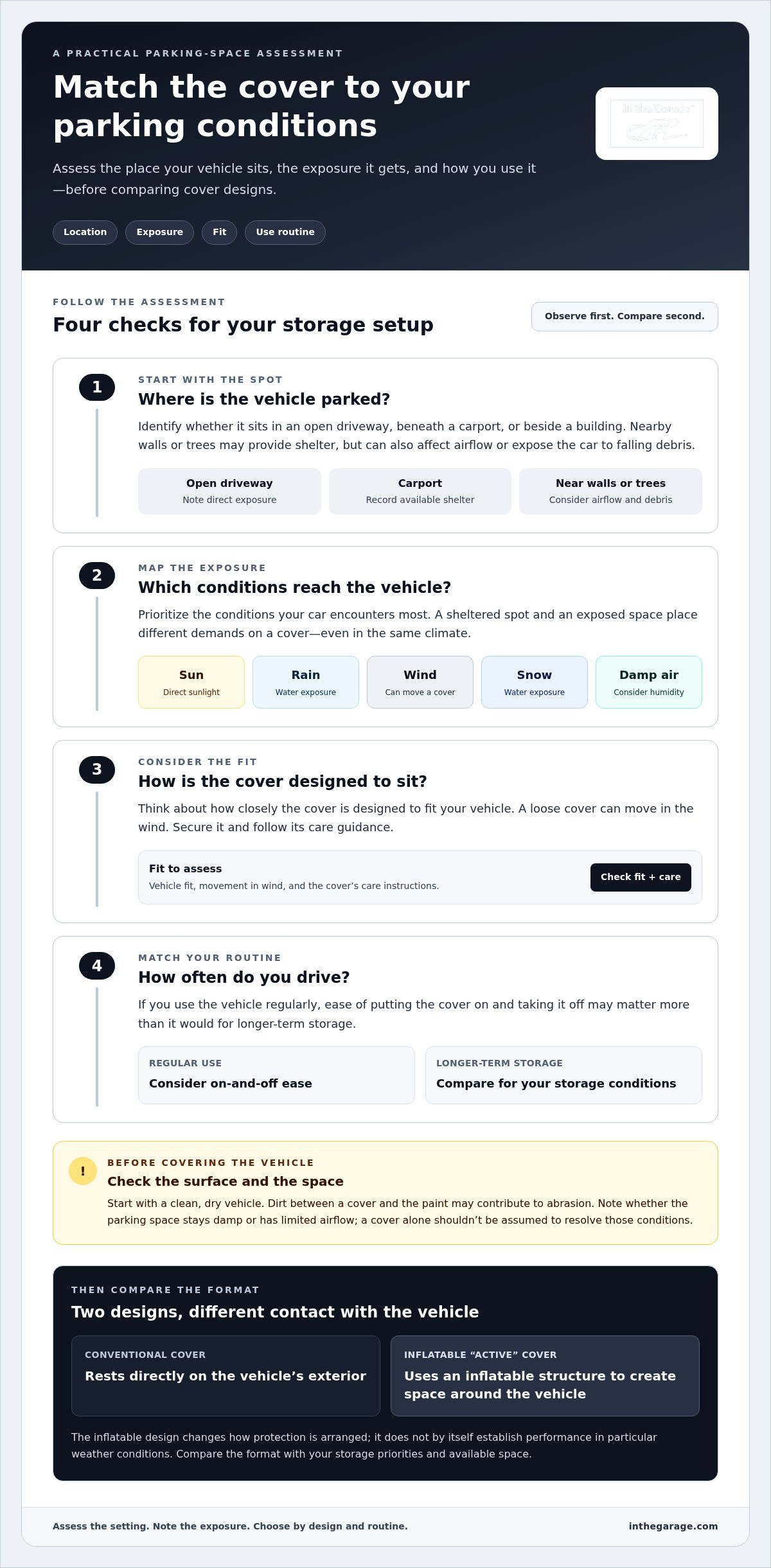
Matching a Weatherproof Car Cover to Parking Conditions
Start by observing where your vehicle sits, then match the cover design to your routine. Use this assessment before comparing weatherproof car covers:
- Parking location: Is the vehicle in an open driveway, beneath a carport, or beside a building? Nearby walls or trees may provide shelter, but can also affect airflow or expose the car to falling debris.
- Exposure: Note which conditions reach the vehicle, including direct sun, wind, rain, snow, or damp air. An exposed space faces different demands from a sheltered spot, so prioritize the conditions your car encounters most.
- Fit: Consider how closely the cover is designed to fit your vehicle. A loose cover can move in the wind. Secure it and use it according to its care guidance.
- Use frequency: Think about how often you drive. If you use the vehicle regularly, ease of putting the cover on and taking it off may matter more than it would for longer-term storage.
Before choosing, note your parking shelter, the weather that reaches the vehicle, and nearby surfaces or objects that could affect its exposure.
Check the vehicle’s condition before covering it. Dirt between a cover and the paint may contribute to abrasion, so begin with a clean, dry surface and follow the cover’s care instructions. Consider moisture too: note whether the parking space stays damp or has limited airflow. A cover alone shouldn’t be assumed to resolve those conditions.
For another perspective on enclosed active protection, read The Rise of Inflatable Garages: A New Era of Vehicle Protection in 2026. To compare vehicle-protection options for your storage setup, explore the vehicle protection collections.
When an Inflatable Active Cover Makes Sense for Weather Protection
An inflatable active cover offers a different design from a conventional cover. Rather than resting directly on the vehicle’s surface, it uses an inflatable structure to create space around the vehicle. That distinction changes how the protection is arranged, but it doesn’t by itself establish how the system performs in particular weather conditions.
How does an active cover differ from a conventional car cover?
| Design | How it sits around the vehicle |
|---|---|
| Conventional cover | Rests directly on the vehicle’s exterior. |
| Inflatable active cover | Uses an inflatable structure to keep the cover from sitting directly on the vehicle’s surface. |
The right format depends on your storage priorities, available space, and how you use the vehicle. Consider an active cover if you want an inflatable system rather than a cover resting on the car. If the vehicle is stored indoors, an indoor car cover is another category to explore; The Ultimate Guide to Indoor Car Cover Solutions: Preservation Science for 2026 focuses on that option.
In The Garage offers Outdoor Shield and Ultimate Shield as part of its vehicle-protection range. Compare these options by their design and intended use, then consider how each fits your storage conditions. Weatherproof car covers and active systems are different approaches, so focus on which format suits your priorities rather than relying on a broad protection label.
Explore the vehicle protection collections to compare outdoor and inflatable options for your setup.
Choose Protection That Fits Your Storage Conditions
The right protection starts with your parking environment, not a broad label. Assess the conditions your vehicle faces, consider fit and care, and decide whether a cover that rests on the vehicle or an inflatable active cover better suits your storage priorities. Weatherproof car covers are intended for outdoor exposure, but their suitability depends on the design and where you store your car.
In The Garage specializes in indoor and outdoor vehicle-protection products. Privately owned by automotive enthusiasts with more than 30 years of industry experience, the brand offers options for different storage needs.
Ready to find an approach that fits your priorities? Explore vehicle protection collections and compare options for your vehicle’s storage conditions.
Frequently Asked Questions
Is a weatherproof car cover the same as a waterproof car cover?
Not necessarily. The terms can describe different kinds or levels of exposure resistance, and neither is a universal guarantee. Check which conditions the specific cover is designed for, then compare them with your parking environment. A broad weatherproof claim shouldn’t be taken to mean complete protection from every combination of rain, wind, sun, snow, and humidity.
Can a weatherproof car cover protect a vehicle parked outdoors all year?
A cover may be designed for outdoor exposure, but the label alone can’t establish whether it suits every climate or parking location. Consider how much sunlight, rain, wind, snow, and humidity reach the vehicle, and whether the space is sheltered. Match the cover’s stated use to those conditions and follow its care instructions.
How do I choose a weatherproof car cover for my parking conditions?
Start by identifying whether your parking space is exposed or sheltered, then note the weather conditions it receives most often. Consider the cover’s fit, intended use, and how frequently you drive the vehicle. Compare conventional covers with an inflatable active cover if you’re considering a different design, and avoid choosing based on one broad protection claim alone.
What is an active car cover, and how is it different from a traditional cover?
An active cover uses an inflatable design rather than resting directly on the vehicle’s surface like a conventional cover. This structural difference offers a distinct approach to vehicle storage, but doesn’t establish specific weather performance by itself. Review the product’s stated design and intended use, then consider whether that format aligns with your vehicle and storage conditions.
Disclaimer
Please note some articles may have AI generated content