


The Fundamentals of Professional Outdoor Car Storage
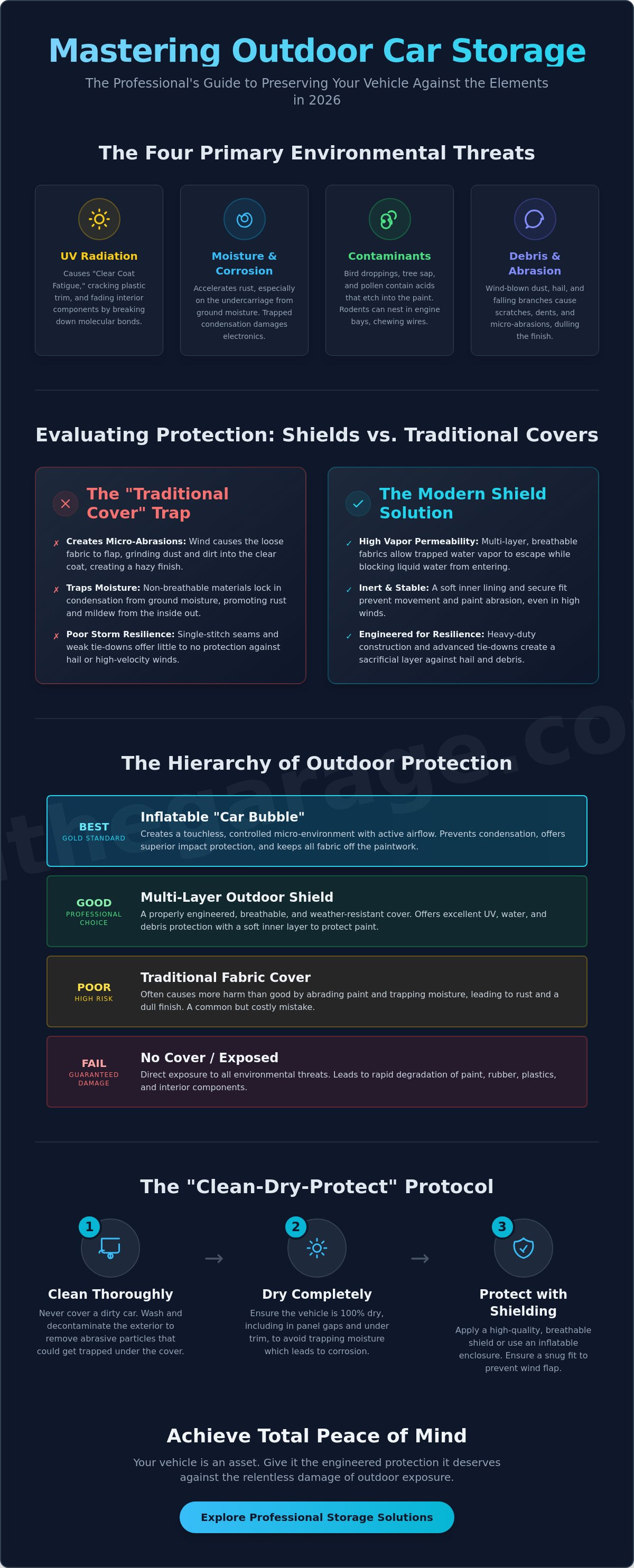
Forget simply parking your car outside. Professional outdoor car storage is the strategic preservation of your vehicle in a non-climate-controlled environment. It's an engineered defense against the four primary threats that relentlessly attack your asset's value: relentless UV radiation, invasive hydrostatic moisture, corrosive biological contaminants, and damaging physical debris.
In 2026, these threats are more potent than ever. Intensified UV levels accelerate a process known as 'Clear Coat Fatigue,' where the protective top layer of your paint oxidizes, cracks, and fails, leaving the colour coat beneath it exposed and vulnerable. To combat this, you need more than a simple dust sheet; you require a physical barrier engineered for the difficult balance of total waterproofing and essential vapour permeability.
The Science of UV and Thermal Degradation
Ultraviolet radiation is a persistent, silent force of decay. Its high-energy rays break down the molecular bonds in your vehicle’s plastics, rubber seals, and dashboard materials, causing them to become brittle, faded, and cracked. This is compounded by the 'Greenhouse Effect' that occurs inside a sealed car. Sunlight penetrates the glass, heating the interior to temperatures far exceeding the ambient air, which systematically bakes leather, degrades adhesives, and can even damage sensitive electronics over time.
Moisture: The Silent Catalyst for Corrosion
When considering outdoor car storage, moisture is the primary enemy. It attacks from two directions: top-down as rain, sleet, or snow, and from below as rising ground moisture. This upward-wicking dampness, driven by hydrostatic pressure, is particularly insidious, creeping into the undercarriage and promoting rust in areas you can't see. For this reason, storing a vehicle on grass or dirt is the single worst mistake an owner can make, as it guarantees constant exposure to a corrosive, humid micro-environment.
Evaluating Outdoor Protection Methods: Shields vs. Traditional Covers
Many owners fall into the 'Traditional Cover' trap. They believe a fabric cover offers adequate protection, only to discover it has caused irreversible damage. When wind whips a conventional cover against a car, the fabric—no matter how soft it claims to be—creates thousands of fine scratches known as micro-abrasions, dulling the finish and ruining the paintwork over time. This constant contact also traps moisture against the surface, creating a perfect breeding ground for mould, mildew, and rust.
The modern solution is the 'Shield' concept—a multi-layered, rugged defense system engineered to isolate the vehicle. Unlike a simple cover, a professional Outdoor Shield is built from military-grade materials designed for total environmental separation. For the ultimate protection, an 'Outdoor Bubble' or inflatable 'active' cover creates a touchless barrier, using continuous airflow to evacuate moisture and maintain a stable, protective micro-environment around your vehicle.
The key to both systems is 'Breathability'—the material's scientific ability to allow trapped water vapour to escape while blocking liquid water from entering. This prevents the condensation that plagues traditional waterproof tarps and covers.
The Ultimate Shield: Engineering for High-Wind and Storm Resilience
As weather patterns intensify, a modern outdoor shield must be engineered for extreme conditions. The material science for 2026 demands heavy-duty, rip-stop fabrics, reinforced seams, and integrated tie-down systems that can withstand high winds and storm conditions without failing. These systems are designed not just to cover, but to secure. Specialized Outdoor Shields are also constructed to absorb and deflect impacts from hail and falling debris, providing a level of physical protection that flimsy covers cannot match. For a deeper dive into the technical specifications, our definitive guide to professional outdoor car covers offers a comprehensive breakdown.
Inflatable Outdoor Enclosures: Creating a Controlled Micro-Environment
Inflatable 'active' covers represent the pinnacle of outdoor car storage science. By circulating filtered air, these systems actively manage the environment inside the enclosure. This constant airflow prevents the air temperature from reaching the dew point, making it physically impossible for condensation to form on your vehicle's surface. This 'touchless' system is the only solution that guarantees no part of the cover ever makes contact with your car's delicate paintwork, completely eliminating the risk of micro-abrasions. It transforms a simple parking space into a controlled, preservation-grade storage unit. Learn more about how these systems are revolutionizing vehicle protection in our guide to the rise of inflatable garages.
The 2026 Outdoor Storage Preparation Checklist
Properly protecting your vehicle begins long before you deploy a shield. Following the 'Clean-Dry-Protect' mantra is non-negotiable. Never, under any circumstances, cover a dirty or damp car. Dirt and grit trapped under a cover will act like sandpaper, while moisture will accelerate corrosion. A thorough wash, dry, and application of wax or ceramic coating should always be the first step.
Beyond the surface, you must prepare for other environmental threats. Rodents are a major problem in outdoor settings, capable of nesting in engine bays and causing thousands of dollars in damage by chewing through wiring harnesses. Furthermore, any vehicle stored for more than 30 days requires careful fluid and battery management to ensure it remains mechanically sound. Finally, preventing 'Tyre Flat-Spotting' is crucial for maintaining vehicle safety and performance upon its return to service.
Rodent-Proofing Your Outdoor Setup
Preventing rodent infestations is a critical part of any long-term outdoor car storage strategy. Start by cleaning the vehicle's interior of any food wrappers or crumbs. Place mothballs or peppermint-oil-soaked cotton balls in the engine bay and trunk, as the strong smells can deter pests. For a more robust solution, sealed outdoor bubbles provide a 360-degree physical barrier that is virtually impenetrable to mice, rats, and other vermin, offering complete peace of mind that your wiring and upholstery are safe.
Mechanical and Surface Prep
Before long-term storage, attend to your vehicle's mechanical needs. Fill the fuel tank to about 90% capacity and add a quality fuel stabilizer formulated for modern 2026 ethanol-blend fuels; this prevents the fuel from degrading and moisture from accumulating in the tank. Over-inflate your tyres by 10-15 PSI to help prevent flat spots from developing. Attach a smart battery tender to maintain the battery's charge. Finally, apply a high-quality wax or a durable ceramic coating. This layer acts as the final line of defense for your paint, providing a sacrificial barrier against any residual moisture or contaminants.
With your vehicle prepared, it's time to provide the ultimate protection. Explore our full collection of professional outdoor shields to secure your vehicle today.
Frequently Asked Questions
-
Can a car cover actually cause more damage when used outdoors?
Absolutely. Traditional car covers that rest directly on the paint can cause significant damage. Wind causes the fabric to buffet against the car, creating fine scratches (micro-abrasions) that dull the finish. They can also trap moisture against the bodywork, promoting rust and mildew.
-
How do I prevent condensation from building up under my outdoor car cover?
The key is breathability and airflow. Choose a high-quality shield made from vapour-permeable materials that allow moisture to escape. For the ultimate solution, an inflatable 'active' cover with a fan constantly circulates air, making it impossible for condensation to form.
-
What is the best ground surface for outdoor car storage?
The ideal surface is a solid, non-porous one like concrete or asphalt. These surfaces drain well and prevent ground moisture from rising into the vehicle's undercarriage. Never store a car on grass, gravel, or dirt for an extended period.
-
How often should I check on my vehicle during long-term outdoor storage?
Even with the best protection, it's wise to check on your vehicle every 2 to 4 weeks. Look for any signs of pests, check that the shield is secure, and inspect tyre pressures. This quick check-up can prevent small issues from becoming major problems.
Disclaimer
Please note some articles may have AI generated content